Do You Need a GoHighLevel Developer or Just a Workflow Builder?
A GoHighLevel developer writes code against the API. Follow these if-then branches to see when you need one, when a builder is enough and what it costs.
By Carlos Familia, CRM & AI automation expert. Updated . 7 min.
I once built a voice AI app that agencies install in their GoHighLevel sub-accounts, used by businesses in legal intake, restoration and dental. The rule sounds simple: each sub-account sees only its own calls. Meeting it took a custom page with single sign-on, call queues, a system health page and a database where every table filters by the signed-in location. Even the small bugs lived in code. One voice default used a voice name where the provider needed an ID.
None of that is a workflow. It sits on the far side of the line between building inside GoHighLevel and writing code for it. Most businesses never cross that line. Some do, and then the hire is different.
You need a GoHighLevel developer only when the job needs code: an integration with another system, a custom screen inside the CRM, or an app that serves many sub-accounts. If the job is pipelines, forms, calendars and texting, you need a GoHighLevel expert who builds workflows, and that costs less.
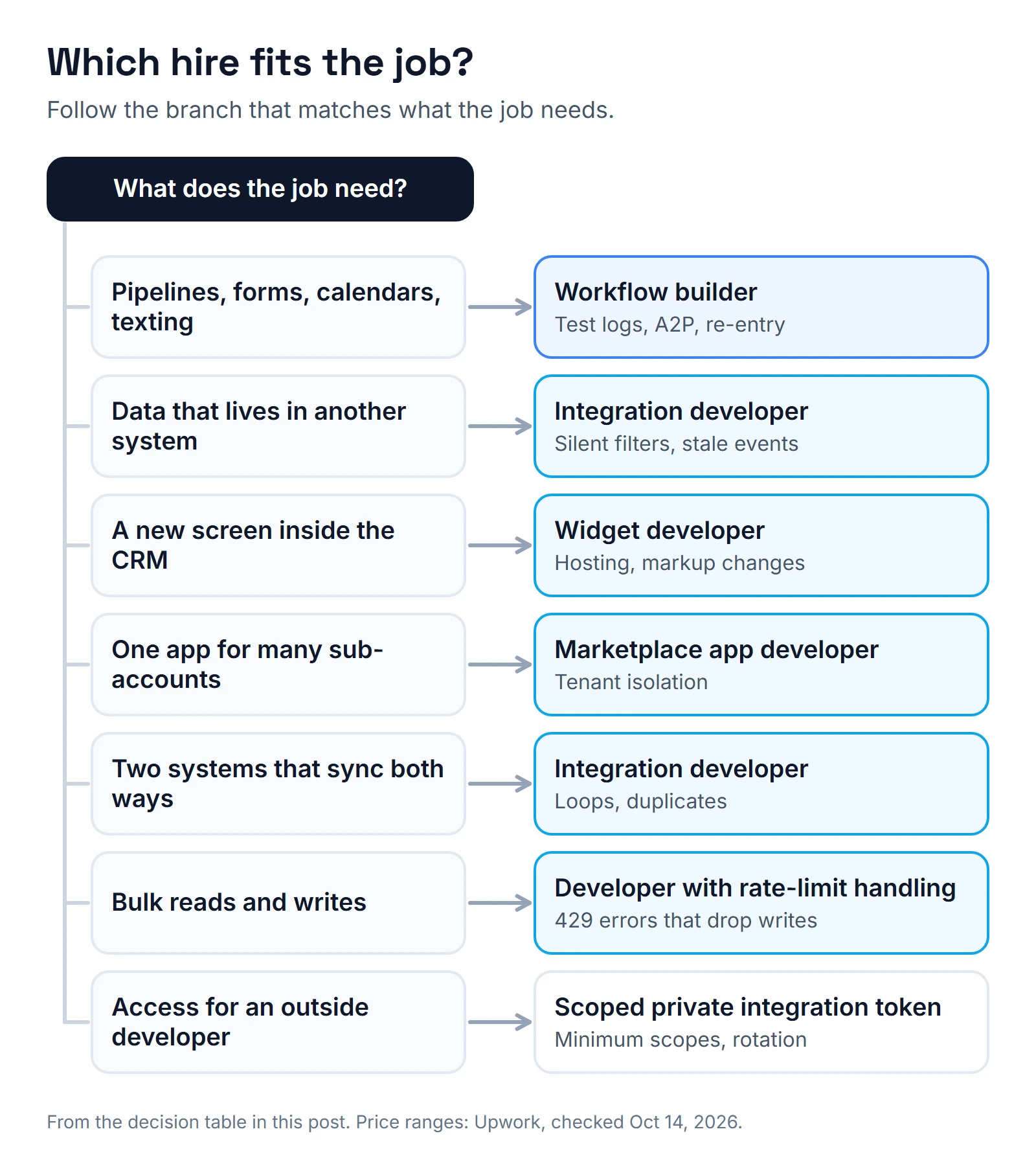
When I checked Upwork's hiring page on October 14, 2026, it put integration-heavy GoHighLevel builds at $1,500 to $6,000 per project, against $300 to $1,200 for an account setup or cleanup. For the full price picture, see how much a GoHighLevel expert costs. Follow the branches below until one fits.
If you need pipelines, forms, calendars, reminders and texting, then hire a builder
A good test is one sentence: "When X happens to a contact, do Y to that same contact." If your job fits it, workflows are enough. Tags, stage moves, tasks, email and SMS sequences, appointment reminders and even a Custom Webhook that sends data out are all workflow features.
Complex logic is still workflow work. For an HVAC company in California, I published 25 logic workflows with zero failures. They include a silence counter, a call cadence of up to six attempts, an estimate follow-up with a "sequence lock" field so sequences never collide, one workflow per objection reason, and a three-month no-show recovery. Those are design problems, and a builder solves them.
You can start with a builder and add a developer later. What matters is that the builder can show test logs and knows the silent failures. I list those in GoHighLevel workflow mistakes, and I describe my test method in how I test GoHighLevel workflows.
If another system holds the data you need, then you need an integration
A mortgage brokerage in Florida kept its loan data in a loan origination system (LOS). The bridge to GoHighLevel was six Zaps in the owner's personal Zapier account. Zap filters dropped 9 records in 7 days, and Zapier counted every one of them as a success.
I moved the logic to n8n. A stale-event guard compares stage order and status date, so an old event cannot overwrite a new one. A reconciler runs every 5 minutes and sends an alert when no LOS ID lands within 15 minutes. The first loan-details sync wrote 808 fields on 402 contacts.
Two more findings from that work show why the old setup was risky. Only 226 of 2,032 contacts carried any LOS ID.
And a repeat client's second opportunity was refused, because the GoHighLevel setting that allows it switched itself off within about two hours. I added an hourly probe that watches that setting. A good integration developer builds the watchers along with the bridge.
If the logic will live in n8n, you may want an n8n developer who also knows GoHighLevel. I compare the two tools in GoHighLevel n8n.
If your team needs a screen GoHighLevel does not have, then you need a custom widget
For a portable storage company in Alabama, I built a custom widget suite for the contact view: a stage stepper banner, a deal card with send-proposal buttons, SMS templates, and dashboards for the quote funnel and the follow-up queue. It works on two locations.
For a beauty-industry marketing agency, I built a dashboard widget that shows 12 KPIs. One edge function makes 14 or more API calls, caches the result for 5 minutes and checks the location before it returns anything.
Widgets are code, so ask who hosts them and what happens when the platform changes. In another account, a GoHighLevel markup change made an agency CSS skin vanish. 86 selectors matched zero elements, and the fix started with counting matches before assuming anything was deleted.
If one tool must serve many sub-accounts, then you need a marketplace app built for isolation
That is the voice app from my opening. It runs as a custom page inside GoHighLevel. A single sign-on token exchange tells the app which location is open, and every table has row-level security keyed to the location inside the signed token. Isolation has to hold in every query, not only on the screen the user sees.
A developer should know three rules before writing the first line:
- A draft marketplace app fires no webhooks, and no app installs without a client key.
- White-label marketplace apps reject redirect URLs that contain "ghl" or "highlevel".
- Every query must be filtered by the signed-in location, and a test must prove an anonymous query returns nothing.
Ask any developer how they test tenant isolation. "I trust the front end" is the wrong answer.
If two systems must stay in sync both ways, then you need loop guards and deduplication
For that same beauty agency I built a two-way sync between GoHighLevel and a salon booking platform, polling every 30 seconds. Four things broke:
- Every sync created duplicate clients until the lookup used email and phone.
- Every appointment arrived as 30 minutes because the duration was hardcoded.
- A variable renamed during a refactor crashed the poller silently.
- The loop guard had to track state. A name prefix was not enough.
If you move many records at once, then you need rate-limit handling
HighLevel's docs set a burst limit of 100 requests per 10 seconds and a daily limit of 200,000, counted per app per resource. A daily call queue I built for the same Florida brokerage scans 1,054 open opportunities. Its first live run silently lost 28 contact reads and 16 tags to rate-limit errors.
After I added retries with backoff and a concurrency of 4, 118 of 118 reads and 43 of 43 tags landed. The run time fell from 152 seconds to 29. Ask every developer what happens when the API answers with a 429.
If you want a developer to access your account, then give a scoped token, not a login
HighLevel's Private Integrations let you pick the scopes a developer can reach. The token is shown once, it does not refresh by itself, and HighLevel recommends rotating it every 90 days.
HighLevel's docs describe the older API keys as less secure, because a developer gets unrestricted access to all account data, and they say API v1 has reached end of life. Any developer who offers to work with an old API key is working with outdated tools. By default, all agency admins can create private integrations, and you can restrict that per user.
Test the exact credential from the exact tool that will run it. In one build, a token that worked in one place failed after extra request headers were added. A developer who has seen that will test early.
If you want an official partner, then start with HighLevel's list
HighLevel runs a Developer Partner Program on its partner site. It lists partners for custom integrations built on the API, consulting to design apps, full-stack development, workflow automation and marketplace deployment. Use it as a starting list and ask the same questions as for anyone else.
Which branch is yours?
| If your job is | You need | Watch for |
|---|---|---|
| Pipelines, forms, calendars, texting | Workflow builder | Test logs, A2P, re-entry |
| Data that lives in another system | Integration developer | Silent filters, stale events, duplicates |
| A new screen inside the CRM | Widget developer | Hosting, markup changes |
| One app for many sub-accounts | Marketplace app developer | Tenant isolation, draft apps fire no webhooks |
| Two systems that sync both ways | Integration developer | Loops, duplicates, hardcoded durations |
| Bulk reads and writes | Developer with rate-limit handling | 429 errors that drop writes |
| Access for an outside developer | Scoped private integration token | Minimum scopes, rotation, exact credential |
About the author

Carlos Familia, CRM & AI automation expert. GoHighLevel, n8n, AI agents, servers. Full-stack developer.
I build CRM systems in GoHighLevel, n8n automations on my own servers and AI voice and chat agents for service businesses. Full-stack developer: I write the workflow, the API integration, the database and the server it runs on, and I test every build with real journeys before handoff.
Book a call with Carlos
In 30 minutes we look at how you get customers today and what to automate first. Pick a time · contact@bluemiraisystems.com