AI Dental Receptionist: The 9 Questions to Ask First
An AI dental receptionist is ready when it passes nine checks: data privacy, symptom handoff, booking, testing, Spanish, outages and call hours. Score yours.
By Carlos Familia, CRM & AI automation expert. Updated . 8 min.
A dental practice uses a call app I built for GoHighLevel agencies to see its AI phone calls. A legal intake firm and a restoration company use the same app, each from its own sub-account. Every table in it is tied to the sub-account the person signed in from. I don't take that on faith: a request from someone signed out, or signed in somewhere else, has to come back empty.
The build had its plain bugs too. One default setting held a voice's name where the voice provider expects its ID. Details like these never show up in a demo, which is why the first question below is about data, not voices.
An AI dental receptionist should answer every call, collect the caller's details and reason, give the office information you approved, and take a booking request. It should hand any symptom, clinical question or insurance-coverage question to a person.
Nine questions separate a receptionist that is ready from one that is a demo. Ask them of whoever is selling or building yours, and score the answers in the table at the end. If you would rather have me run them against your vendor, the calendar below is open. The wider picture is in how AI receptionists work.
What should you ask before an AI receptionist answers your dental line?
1. Can anyone outside my practice see my calls and recordings?
A good answer sounds like: "Each practice sees only its own calls. Here is the test: a request from a signed-out user and one from another practice's user both come back empty."
A bad answer sounds like: "It's secure." No test, no proof of the failure case.
Ask for the test result, not the assurance. It is the first check I run on my own app.
2. What happens when a caller describes a symptom?
A good answer sounds like: "It stops the booking script, says one sentence your dentist approved, and alerts or transfers staff. We tested it with an urgent caller."
A bad answer sounds like: "The AI decides whether it's serious."
I tested a receptionist for a med spa in California with a second AI agent that called it and graded the answers. The receptionist mis-triaged an urgent symptom. Separately, a confirmed request was lost when an emergency came up in the same breath. Dental offices get callers in pain, so write this script with your dentist and never let the agent judge severity.
3. Where does the appointment actually get written?
A good answer sounds like: "Into the system we named, through a tool that returns slot codes and spoken labels, or as a booking request your staff confirm."
A bad answer sounds like: "It books into whatever you use."
That med spa books in a separate system, so its receptionist takes a booking request instead. A dental CRM can hold the request until the front desk confirms it.
For a facial spa in New Jersey, the voice agent resolves "tomorrow" on the server. An earlier bot there booked today when the caller said "tomorrow (Saturday)", because the tool had no date field and the server clock ran on UTC. The model should never handle timestamps.
4. How did you test it?
A good answer sounds like: "Here is a graded suite, here are the failures it found, and here is the retest."
A bad answer sounds like: "I called it a few times and it worked."
My suite for the California med spa had 24 questions, run by text and by phone. Among its findings: the receptionist said "alerting the team" without calling the tool that does it, tagged a first-time caller as existing, and skipped the digit read-back.
The core suite scored 14 out of 15 by phone, in a call that ran 467 seconds. By text it scored 13 to 14 of 15, and an extra suite scored 8 of 9. Each phone run cost about $1.80 and each text run $0.23, which is why testing belongs in the AI receptionist cost budget.
5. How does it handle words it mishears?
A good answer sounds like: "We use accurate transcription, boost your procedure names, spell back every email address and read back every phone number."
A bad answer sounds like: "Our speech recognition is very accurate."
On a phone agent for a tattoo studio in California, fast transcription turned "a tattoo" into "account two". Accurate mode plus boosted phrases fixed it.
Boosting has a cost, though. In the med spa tests a boosted keyword skewed the transcription of an email domain, and the spell-back caught it. Test your own vocabulary, such as crown and root canal.
6. Does it work in Spanish, by phone?
A good answer sounds like: "A native speaker called it in Spanish. Voice, model and language are matched, and a hard rule makes it answer in the caller's language."
A bad answer sounds like: "It supports 30 languages."
In a demo for clinics in the Dominican Republic, the first Spanish voice mangled the pronunciation. The cause was an American-accent voice on a fast English model, and an empty voice-model setting made it robotic on top of that. The language model also drifted back to English until I added a hard Spanish rule. In the California tests, a Spanish speaker got English too.
7. What happens when it goes down or the balance hits zero?
A good answer sounds like: "Balance alerts, a fallback number that rings the office, and a check that counts real calls instead of trusting a success flag."
A bad answer sounds like: "It doesn't go down."
At a life insurance agency in California, eight client numbers ran on a single prepaid voice account. One empty balance took all eight offline, and three inbound calls during that outage may have been real prospects. In a separate build, a dialer still reported "success" while an empty voice balance produced 79 failed dials.
8. Who signs what for patient information, and where do recordings live?
A good answer sounds like: "Here is every vendor that touches audio or transcripts: the voice platform, the language model provider, the phone carrier and the recording storage. Here is which will sign a business associate agreement and on which plan. Here is how long recordings are kept. Confirm it all with your compliance advisor."
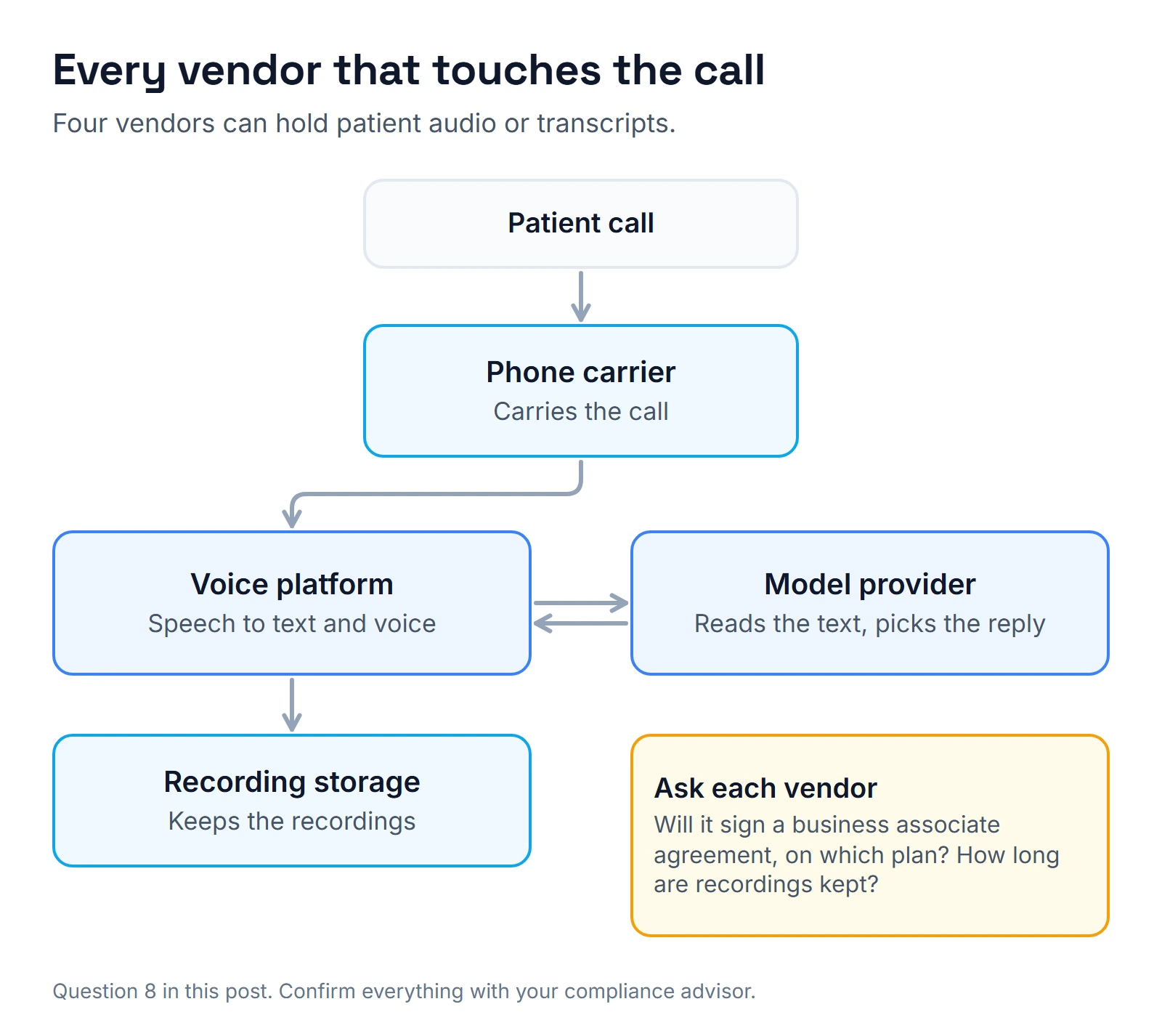
A bad answer sounds like: "We're HIPAA compliant," with no document behind it.
I don't certify anyone's setup as compliant. The federal rule, 45 CFR 164.502, permits a covered entity to disclose protected health information to a business associate if it obtains satisfactory assurance. That assurance must be documented in writing, in a contract or a similar agreement.
HighLevel's HIPAA help article shows how one vendor handles it. As of its June 2026 update, it says a HighLevel account starts out without HIPAA compliance, and it sells HIPAA as an add-on that includes a signed agreement.
On a California build, the compliance review added two things to the calls: an AI disclosure and a recording notice. Ask your advisor what applies in your state. The healthcare page lists the other builds I have done in this space.
9. When does it call patients, and who said it could?
A good answer sounds like: "Calls go out between 8 a.m. and 9 p.m. in the patient's time zone, taken from the area code. Unknown area codes are skipped. There is a kill switch, and consent is confirmed with your advisor."
A bad answer sounds like: "Whenever the schedule says."
Under the federal telemarketing rule, solicitation calls to residential lines are off limits before 8 a.m. and after 9 p.m., counted in the local time of the person being called (47 CFR 64.1200). Ask your advisor whether your recall calls count as solicitations.
The outbound dialer I built for a med spa keeps to that window in the lead's own time zone. It has two kill switches and a rehearsal mode that sends test contacts down a safe path. For more on clinic voice agents, see AI voice agent in healthcare.
How do you score the answers?
Give each answer 0 for a bad answer, 1 for a partial one and 2 for a good one.
| # | Question | Score 2 when you get | Score 0 when you get |
|---|---|---|---|
| 1 | Data privacy | A shown test that returns nothing from outside | "It's secure" |
| 2 | Symptoms | A dentist-approved script and instant handoff | The AI judges severity |
| 3 | Booking | A named system, slot codes or a staff-confirmed request | "Whatever you use" |
| 4 | Testing | A graded suite with failures listed | A few test calls |
| 5 | Mishearing | Accurate mode, boosted terms, spell-back | "Very accurate" |
| 6 | Spanish | A phone test by a native speaker | A language count |
| 7 | Outages | Balance alerts and a fallback number | "It doesn't go down" |
| 8 | Vendor contracts | A vendor list, agreement status and retention period | "We're compliant" |
| 9 | Call hours | Patient time zone window and a kill switch | "Whenever" |
| Total (out of 18) | What it means |
|---|---|
| 16 to 18 | Ready for a pilot on after-hours calls |
| 12 to 15 | Fix every zero, then retest |
| 0 to 11 | Not ready for patients |
About the author

Carlos Familia, CRM & AI automation expert. GoHighLevel, n8n, AI agents, servers. Full-stack developer.
I build CRM systems in GoHighLevel, n8n automations on my own servers and AI voice and chat agents for service businesses. Full-stack developer: I write the workflow, the API integration, the database and the server it runs on, and I test every build with real journeys before handoff.
Book a call with Carlos
In 30 minutes we look at how you get customers today and what to automate first. Pick a time · contact@bluemiraisystems.com