How Do AI Receptionists Work? One Call, Step by Step
How do AI receptionists work? Follow one phone call from ring to booking: speech to text, the model, tools, handoff, plus a criteria table for choosing one.
By Carlos Familia, CRM & AI automation expert. Updated . 9 min.
A second AI agent phoned a receptionist I had built for a med spa in California and worked through a list of questions, including one where it read out an email address. The receptionist heard the wrong domain, because a keyword I had boosted in the speech recognizer biased the transcript. The receptionist's spell-back step caught the mistake.
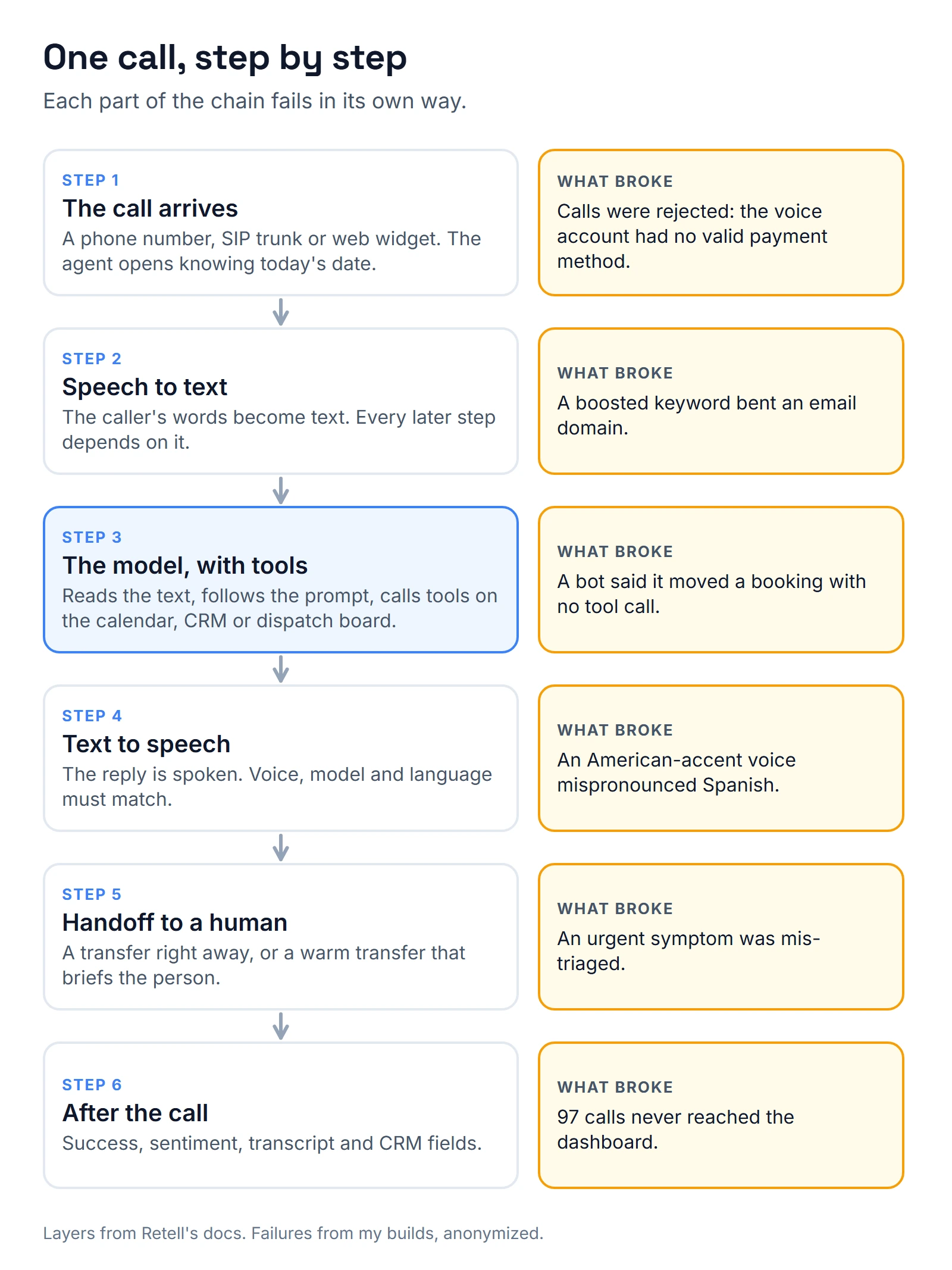
That one test shows how an AI receptionist really works. It is a chain of parts, and each part fails in its own way. Once you can see the chain, you know what to ask before you trust one with your phone.
The short answer: an AI receptionist answers your calls with four layers working together. Retell's documentation describes them as telephony (the call arrives), speech to text (the caller's words become text), a language model that "picks the reply, using your prompt and tools", and text to speech (the reply is spoken). Around those layers sit a handoff to a human and a record of the call afterward.
Here is one call, step by step.
Step 1: The call arrives and the agent opens with context
The call reaches the agent through a phone number, a SIP trunk or a web widget. Before the first word, a good setup tells the agent what it needs to know right now.
In the med spa build, an init webhook injected today's date and the upcoming open days. The agent also used fixed spoken replies for each reason a caller might give.
Calls also depend on billing. At a tattoo studio in California, calls were rejected because the voice account had no valid payment method.
The greeting matters more than people expect. At the same studio, piercings never came up because the greeting only said tattoos. Say everything you do in the first sentence.
Step 2: Speech to text hears the caller
The caller's audio is transcribed as they talk, and every later step depends on that text. If the transcript is wrong, the best prompt in the world can't help.
Two real examples. At the tattoo studio, fast transcription turned "a tattoo" into "account two", and accurate mode plus boosted phrases fixed it. At the med spa, a boosted keyword bent an email domain, and only the spell-back caught it.
What to check: does the agent read digits and email addresses back? Mine skipped the digit read-back at first, until the test suite flagged it.
Step 3: The model decides what to say
The language model reads the transcript, follows your prompt and decides whether to answer, ask a question or call a tool. Voice agents come in two shapes. A single prompt agent is the usual starting point. A conversation flow splits the call into nodes for tighter control over a fixed sequence.
Settings decide how natural it sounds. For an HVAC company in California, a model temperature of 0.2 was a hidden cause of a robotic voice. Raising it to 0.75 helped, and backchannel was the bigger win.
Rules also decide what the agent asks. A restaurant chain in California took pickup orders by phone with custom changes. I wrote the agent to ask "any changes, like no tomato?" only on savory items, never on drinks, desserts or plain sides.
Good rules branch on the situation. For collision repair shops in California, one inbound agent skipped the empathy opener for price shoppers, asked about towing only when the car wasn't drivable, and asked about the other driver's insurer only when the caller wasn't at fault.
Give the agent the facts, too. The tattoo studio's agent once invented a location in another country, so state your real details and tell it what to say when it doesn't know.
Some rules must live in code, not in the prompt. One chat bot kept asking for a time in every single reply, whatever the prompt said. Only a limit written in code stopped it.
Step 4: Tools do the real work
A tool is how the agent reads or writes your systems: a calendar, a CRM, a dispatch board. Retell calls them custom functions. The agent calls one when your prompt and the function's description point to it, so a vague description is the most common reason a tool never fires.
The call pauses while your server answers. Retell's custom function documentation says the default timeout is 2 minutes, failed requests aren't retried by default, and the response body is converted to a string and handed to the model.
A failure I saw shows why this matters. A chat agent for a facial spa in New Jersey, built straight from raw API calls, received every tool result as an empty string. It invented times, prices and bookings. The fix was to clone a workflow that was known to work.
Three design rules came out of these builds:
- Tools return slot codes and spoken labels. The model should never handle raw timestamps.
- Resolve relative days like "tomorrow" on the server. One agent booked "tomorrow (Saturday)" for today, because its tool had no date field and the prompt used server time (UTC).
- A booking is real only when the tool reports success. A med spa bot in New Jersey once told a client the appointment had moved to Friday. No tool had been called, the weekday was wrong, and the client arrived for an appointment that didn't exist.
For the HVAC company, the tool wrote service requests to a dispatch board that keeps transcripts and recordings. For the restaurant chain, an n8n workflow computed totals and an order ID.
Step 5: Text to speech and turn-taking
The reply is turned into audio and streamed to the caller. Retell says it handles turn-taking, interruptions and background noise between the layers, so the agent doesn't talk over the caller.
Voice choice has traps. A Spanish-language agent for a clinic in the Dominican Republic mispronounced nearly everything, because an American-accent voice ran on a fast English model. An empty voice model setting also made it sound robotic. Voice, model and provider have to match the language.
Step 6: Handoff to a human
When the agent can't help, it transfers the call. Retell's overview describes two ways: right away, or as a warm transfer that briefs the person first.
Decide in advance what triggers a transfer. At the med spa, the suite found the receptionist mis-triaging an urgent symptom, and a confirmed request vanished when the caller mentioned an emergency right after it. Test both on a real phone.
Step 7: After the call, the data goes somewhere
After the call, Retell scores success and sentiment and can sync custom fields to your CRM.
In the HVAC build, a dispatch board gave staff the transcript and recording for every request. For an Irish fuel distributor, I learned how much this step matters: 97 calls had never reached the dashboard, so about a third of the traffic was invisible until I backfilled them.
Add monitoring too. At a med spa in Pennsylvania, an empty voice balance produced 79 failed dials while every run reported success. See AI receptionist cost for how to budget for the balance.
Step 8: Test the whole chain before launch
The suite from the opening had 24 questions. I ran it twice over: once as text chats, and once as real phone calls placed by a QA agent that graded every answer. On the phone, the core set scored 14 of 15, over a 467-second call. The text core suite scored 13 to 14 of 15, and an extra suite scored 8 of 9.
Each graded phone run cost me about $1.80, and each text run about $0.23. Rerun the suite after every prompt change, because a fix in one place can break another.
What makes the best AI receptionist?
I won't rank products. A ranked list tells you who won someone else's test, and this table lets you run yours. The best one for you passes the checks below, so use the table in every demo and again on your own calls.
| Criterion | What good looks like | How to check it |
|---|---|---|
| Books on your real calendar | The booking appears on your calendar | Book a test slot, then open the calendar |
| Honest about actions | It never says "booked" or "alerted" without a successful tool result | Ask for the tool-call log of one booking |
| Handoff to a person | Warm transfer to a staffed line, with a fallback message | Ask for a human, on a real phone |
| Limits | It knows what it must not answer, such as medical, price or legal questions | Ask something out of scope |
| Language and voice | Voice, model and language match; names are pronounced correctly | Call in your callers' languages |
| Call data | Recording, transcript and summary land in your CRM | Place a call and find it |
| Test evidence | A written report that lists failures and their fixes | Ask for it |
| Failure alerts | An alert for zero balance, a dead number or silence | Ask who receives it |
| Account ownership | Accounts in your name, billing explained | Ask whose card is attached |
| Outbound rules | Calling hours and consent are handled | Ask how it picks the time zone |
To turn this table into interview questions, see what I check before hiring an AI automation consultant.
Do AI receptionists make outbound calls?
Some do, and calling out is regulated in ways that answering is not.
The FCC ruled in February 2024 that AI-generated voices count as an artificial voice under the TCPA, so callers generally need the called party's consent, as Wiley's summary of the ruling explains. On timing, the federal rule for telephone solicitations to residential subscribers allows them only between 8 a.m. and 9 p.m. in the called party's local time.
For a med spa in Pennsylvania, I built an outbound speed-to-lead caller that checks the lead's time zone from the area code and doesn't dial numbers it can't place. Consent rules vary, so ask counsel before you switch outbound calling on.
If calls are your problem but a voice agent is more than you need, start with missed call text back.
For an HVAC example end to end, see the HVAC AI receptionist case and HVAC CRM. Dental practices have extra needs, and the AI dental receptionist post covers them. What breaks months later is in my n8n AI agent notes. To go over your own phone line with me, book a call.
FAQ
Do AI receptionists replace a human?
No. They answer, qualify, book and hand off, while people handle exceptions and urgent cases. The med spa suite caught the receptionist mis-triaging an urgent symptom, so I'd keep a human on any medical or high-value call.
Can an AI receptionist book into my calendar?
Yes, through a tool connected to your calendar. The booking is real only when the tool reports success, so ask to see the log of one booking.
Does it work in Spanish?
Yes, but the voice, the model and the language setting all have to match. A California life insurance agency's Spanish line passed its phone test in full, on a call of just over two minutes. During the med spa tests, one Spanish-speaking caller was answered in English until I fixed it.
What happens when the AI can't help?
It transfers the call to a person or takes a message. Decide in advance what triggers a transfer, who answers, and what happens when nobody does.
Do callers need to be told it is an AI?
On a California life insurance build, a compliance review led me to add a notice that the caller is talking to an AI and that the call is recorded. Requirements change from state to state, so ask counsel about yours.
About the author

Carlos Familia, CRM & AI automation expert. GoHighLevel, n8n, AI agents, servers. Full-stack developer.
I build CRM systems in GoHighLevel, n8n automations on my own servers and AI voice and chat agents for service businesses. Full-stack developer: I write the workflow, the API integration, the database and the server it runs on, and I test every build with real journeys before handoff.
Book a call with Carlos
In 30 minutes we look at how you get customers today and what to automate first. Pick a time · contact@bluemiraisystems.com