AI Voice Agent for Real Estate: 7 Red Flags Before You Buy
What an AI voice agent for real estate should do, what it costs per minute, and 7 red flags to check before you pay, from voice agents I built and tested.
By Carlos Familia, CRM & AI automation expert. Updated . 7 min.
A homeowner on r/RealEstate described a call asking whether they wanted to sell. It sounded like a person, until a short lag and too much politeness gave it away. When they asked if it was a robot, "it dodged the question a couple of times before finally admitting" it was an AI assistant for a real estate investment firm. They had never opted in, so they asked the subreddit whether the call was even legal and put their number on the Do Not Call list. The firm got a public complaint instead of a lead.
I haven't deployed a voice agent for a real estate team. My real estate work is the call logging and lead queue side, and my voice agents run in med spas, HVAC, insurance, collision repair and restaurants. The red flags below transfer because the failure points are the same: consent, dialing rules, balances, tool calls and logging.
A good AI voice agent for real estate calls only people who opted in, says it's an AI when asked, reaches a lead within about a minute, asks a few qualifying questions, and books a showing or hands the lead to a person. It doesn't replace the agent. The platform I use, Retell, lists a headline range of $0.07 to $0.31 per minute on its pricing page as of October 14, 2026. The price is the easy part. These are the failures that cost money.
Red flag 1: Nobody can say who consented, when the agent may call, or how it introduces itself
What it looked like. The Reddit call above is the bad version. Since February 8, 2024, the FCC treats AI-generated voices as an artificial voice under the TCPA, which generally requires prior express consent. Telephone solicitations to a home phone also can't happen before 8 a.m. or after 9 p.m. at the called party's location.
On the AI caller I built for a med spa in Pennsylvania, the lead's time zone comes from the area code, calls go out only between 8 a.m. and 9 p.m. there, and an unknown area code is not dialed. There are two kill switches, and test contacts run in a rehearsal mode. For a life insurance agency in California, the voice agent now says it's an AI and that the call is recorded, both added after a compliance review. For a capital-raising real estate firm in Washington State, nothing public or live-messaging could start until the firm's counsel approved.
I'm not a lawyer, and an area code is a proxy, not proof of where someone is standing.
Ask instead: Where is each lead's consent stored? What does the agent say when someone asks "are you a robot?" How do you choose the time zone, and what happens with an unknown area code?
Red flag 2: The quote is one price with no per-minute breakdown
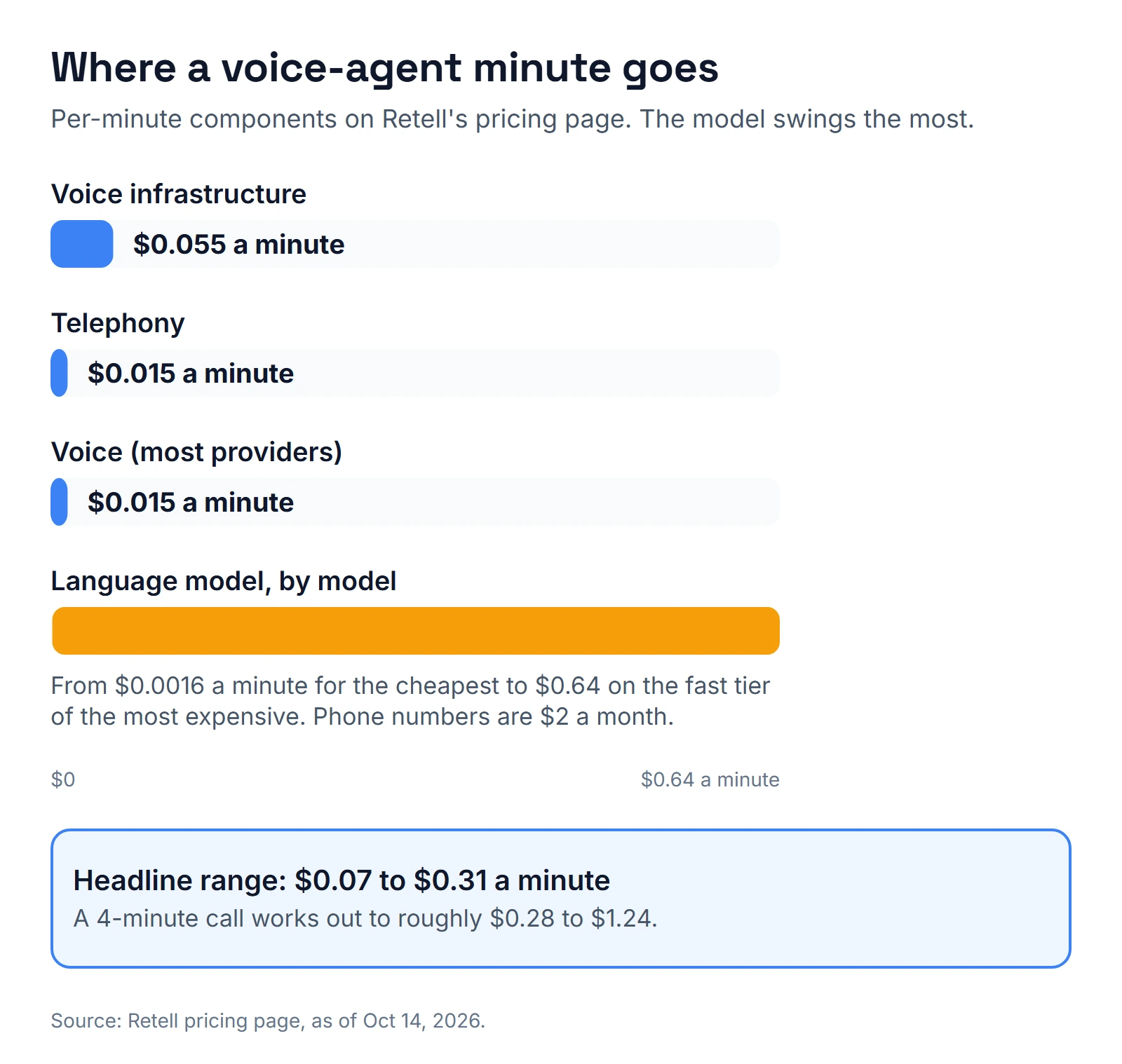
What it looked like. The Retell pricing page splits a call into parts: voice infrastructure at $0.055 per minute, telephony at $0.015, voices mostly at $0.015, and a language model priced by model. The model prices listed run from $0.0016 a minute for the cheapest to $0.64 for the fast tier of the most expensive, so the model you pick matters. Phone numbers are $2 a month. At the headline range, a 4-minute call works out to roughly $0.28 to $1.24.
Testing costs money too. In my voice QA runs, one full phone test cost $1.80 and one text test $0.23. Prices change, so check the page before you budget. For more on pricing, see AI receptionist cost.
Ask instead: Which platform and model? Who pays usage, you or the builder? What's the per-minute cost at my expected call volume?
Red flag 3: The demo is a recording, not a graded test
What it looked like. For a med spa in California, I ran a 24-question suite by text and by phone. A second AI agent dialed the receptionist and graded each answer. It found problems no demo call would have:
- The agent said it was alerting the team without calling the tool.
- It tagged a first-time caller as an existing one.
- It skipped reading the phone number back digit by digit.
- A confirmed request was lost when an emergency came up in the same breath.
- A Spanish speaker got English.
- A boosted keyword biased the transcription of an email domain, which spell-back caught.
The phone core run scored 14 of 15, and the text core run 13 or 14 of 15. Those are real scores, and the misses are the point.
Ask instead: Show me graded transcripts of at least 20 questions by phone, not one hand-picked call.
Red flag 4: The agent says it did something it didn't do
What it looked like. On a med spa chat bot, the agent told a client "I moved you to Friday" with zero tool calls, and it got the weekday wrong. The client showed up to no appointment. Another bot, for an insurance agency, told leads "you're booked" while the calendar stayed empty.
The fix is structural. A change counts as real only when the tool reports success, and the agent can say "booked" only after that. For a showing, the same rule applies.
A related failure: on a facial spa's bot built from raw API calls, every tool result reached the agent as an empty string, so it invented times, prices and bookings. I fixed it by cloning a workflow that already worked. More of these are in what broke when I ran n8n AI agents.
Ask instead: Show me the tool-call log for a booked showing. Where does the log say the booking succeeded?
Red flag 5: The model is trusted with dates and times
What it looked like. On a facial spa's booking bot, "tomorrow (Saturday)" booked today. The tool had no date parameter, and the clock the prompt used ran on server time, which is UTC, so "today" is wrong every evening in a US time zone.
My rule now: tools return slot codes and spoken labels, and the model never handles timestamps.
Ask instead: Who computes "next Tuesday", and in which time zone?
Red flag 6: One prepaid balance, no alert at zero
What it looked like. The med spa caller in Pennsylvania phones every new Facebook lead about 45 seconds after the form arrives. Before it went live, 58 form leads with a phone number had come in over 14 days and none had been called. After launch, the voice platform credit ran out, and the dispatcher kept ending its runs as "success": 79 dial attempts failed and 11 Facebook leads were never called.
The same California insurance agency had one prepaid voice account behind 8 phone numbers. When the balance ran out, all 8 numbers went dead, and 3 inbound calls during the outage may have been real prospects.
A good setup alerts before the balance hits zero. It also has a watchdog that reports a failed dial as failed. Mine now alerts only when it has evidence, and it catches this exact case: a run that reports success while the dials fail.
Ask instead: Whose balance is it? What alerts at low balance? What does the dispatcher report when dials fail?
Red flag 7: Calls and the CRM never get compared
What it looked like. A fuel distributor in Ireland used a voice agent whose post-call webhook assignment silently became null. Nothing errored, and there were zero executions. I also built a reconcile job to find calls the system had never logged, and it backfilled 97 of them, about a third of all traffic. The dashboard went from 218 to 315 calls, and the true answer rate was about 27%.
For a mortgage brokerage in Florida, a transcript note now lands on the contact about 2 minutes after a call. I also learned there that call logs can arrive about 7 minutes late, so a daily count has to wait for stragglers. For a wholesaler, I write one daily note per contact. You can read how that job works in the real estate investor CRM checklist.
Ask instead: How do you compare the count of calls in the voice platform against the CRM each day?
What's the six-line checklist I'd hand a real estate team?
- Calls only leads with stored consent, admits it's an AI when asked, and dials only between 8 a.m. and 9 p.m. in the lead's time zone.
- The quote shows per-minute parts and who pays usage.
- Graded test calls by phone, with transcripts.
- A tool-call log proves every "booked".
- Tools return slot labels, never raw timestamps.
- Low-balance alerts and a daily call count that matches the CRM.
For how these agents work end to end, read how AI receptionists work. If you're choosing a builder, hiring an AI automation consultant covers what to ask. You can also book a call on the calendar below.
About the author

Carlos Familia, CRM & AI automation expert. GoHighLevel, n8n, AI agents, servers. Full-stack developer.
I build CRM systems in GoHighLevel, n8n automations on my own servers and AI voice and chat agents for service businesses. Full-stack developer: I write the workflow, the API integration, the database and the server it runs on, and I test every build with real journeys before handoff.
Book a call with Carlos
In 30 minutes we look at how you get customers today and what to automate first. Pick a time · contact@bluemiraisystems.com