AI Voice Agent in Healthcare: 8 Myths and What Testing Showed
An AI voice agent in healthcare can answer calls and take booking requests, but it should not triage symptoms. Eight myths, checked against real test results.
By Carlos Familia, CRM & AI automation expert. Updated . 7 min.
I built an AI receptionist for a med spa in California that books in a separate system. Before a real caller touched it, I ran a 24-question suite against it, by text and by phone. A second AI agent dialed in and graded the answers.
The loop found seven failures, and I fixed them all:
- It told callers it was "alerting the team" and never called the alert tool.
- It mis-triaged an urgent symptom.
- It marked a first-time caller as an existing one.
- It never read phone digits back.
- A request it had confirmed vanished when an emergency came up in the same sentence.
- A Spanish speaker got English replies.
- A keyword I had boosted bent the transcription of an email domain.
On the phone, the core suite scored 14 of 15 in a 467-second call. That score alone would not have shown me the list above, which is why I read failures, not just scores.
An AI voice agent in healthcare can answer calls, take booking requests, give approved office information and speak Spanish. It should not triage symptoms, give clinical advice, promise insurance coverage or write health details into your CRM. Here are eight myths I have seen fail in testing, and what I saw instead. The same checks for a dental office are in my AI dental receptionist guide.
Myth: The agent can tell when a symptom is urgent
In my tests it could not. Two of the seven failures above were exactly this: a mis-triaged symptom and a confirmed request lost to an emergency.
The fix is a script, not a smarter model. Your clinician approves one sentence for any symptom call, and the agent then alerts or transfers staff immediately.
In that receptionist the spoken reply for each call reason is fixed text, and an init step hands the agent today's date and the next open days so it does not have to guess either. I do not write clinical wording myself. The agent never judges severity.
Myth: If the prompt says "alert the team", the team is alerted
My receptionist said it was alerting the team and called no tool at all. A prompt can describe an action, but only a tool call performs it.
In a chat bot for another client, a prompt rule alone did not stop the bot from asking for a time in every reply. A limit in code did. When you test, read the tool-call log, not just the transcript, and test the handoff by phone.
Myth: If the dashboard says it is running, it is working
Three stories say no.
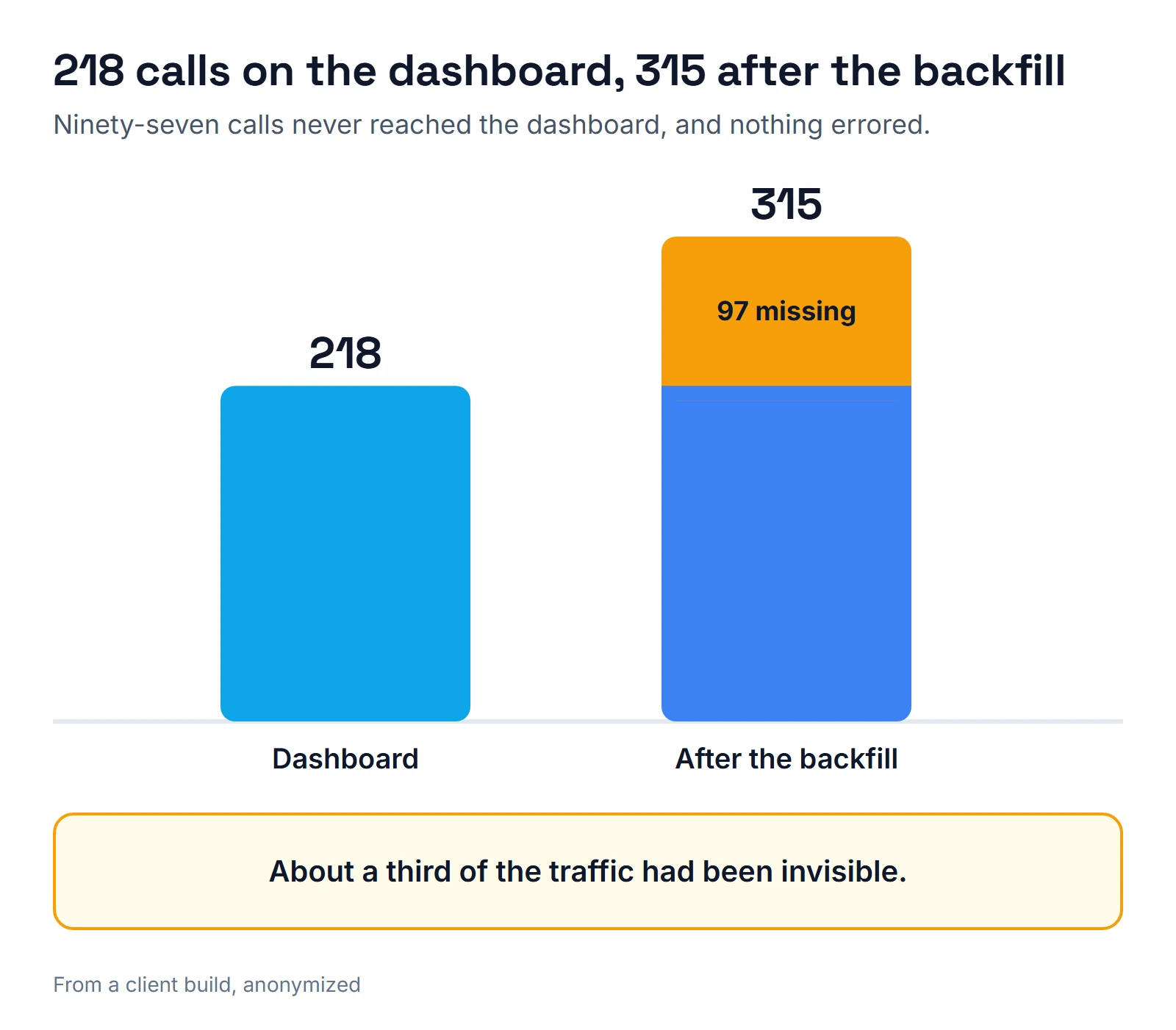
- Invisible calls. For a fuel distributor in Ireland, the voice platform's post-call webhook assignment silently went empty, and nothing errored. I backfilled 97 missing calls, about a third of the traffic, and the dashboard went from 218 calls to 315.
- One empty balance. A life insurance agency in California had eight phone numbers billed to one prepaid voice account. The credit ran out and every one of them went dead at once. Three people called in during that outage, and they may have been real prospects.
- A dialer that said success. At a med spa in Pennsylvania, the voice credit hit zero while the dispatcher kept logging "success". The outage left 79 failed dials and 11 Facebook leads nobody called.
My watchdog there now counts failed dials as evidence and alerts on them. Ask your builder what alerts you when calls stop. Count calls at the phone carrier as well as in the dashboard, and compare the two every week. Set balance alerts too, so an empty account warns you before it silences the line.
Myth: A robotic voice is just how AI sounds
In my builds, settings caused most of it. For an HVAC company in California, I raised the model temperature from 0.2 to 0.75, and adding backchannel (the small "mm-hm" and "I see" a listener makes) was the biggest win.
In the Dominican Republic demo, the culprit was an empty voice-model setting. Voice, model and provider have to match. The speech engine also read the assistant's Spanish name as an English word, so we changed the name.
Myth: A bilingual agent is bilingual
The California receptionist answered a Spanish speaker in English. The Spanish voice in my demo for clinics in the Dominican Republic pronounced everything wrong at first. I had paired an American-accent voice with a fast English model. The language model also kept replying in English until a hard Spanish rule went into the prompt.
Test in Spanish by phone with a native speaker. Also check the channel. SMS to that country was costly per message segment and had no local numbers, so the OB-GYN practice there got its confirmations on WhatsApp, where patients answer 1 to confirm or 2 to reschedule. The demo's dashboard numbers were sample data, so I cite no results from it.
Myth: "HIPAA compliant" on a vendor's site covers my agent
Nobody can hand you compliance with a badge, and I don't claim it for any build of mine. The official sources say this much.
HighLevel's HIPAA help article, in its June 2026 version, states that HIPAA compliance is a paid upgrade and that accounts do not have it by default. The upgrade comes with a signed business associate agreement. Federal rules define a business associate as someone who handles protected health information on behalf of a covered entity, or who provides certain services that involve receiving it.
Under 45 CFR 164.502, the covered entity needs satisfactory assurance from that business associate, and the assurance has to be put in writing. A voice agent is a chain of vendors: whoever runs the voice, the model behind it, the phone carrier and wherever recordings are stored. Ask each link what it will sign and on which plan, and ask your compliance advisor.
Two more questions belong on the list.
First, how does the vendor prove that one clinic cannot see another's calls? Ask to see a request from another account come back empty. Second, what does your advisor want said at the start of a call? When an insurance agency in California had its build reviewed for compliance, the review asked for two additions: telling callers they are talking to an AI, and telling them the call is recorded.
Separately, I would keep health details out of the CRM. Store the appointment time, the provider and a reason category, not a free-text summary of what the caller said. Ask your builder what the post-call summary contains.
Myth: Outbound calls are fine whenever the lead is awake
Time of day is regulated. 47 CFR 64.1200 says no one may start a telephone solicitation to a residential subscriber before 8 a.m. or after 9 p.m., by the clock where the called party is. Whether your patient calls count as solicitations, and what consent they need, is a question for your advisor.
For the Pennsylvania med spa, the dialer reads the lead's time zone from the area code, refuses unknown area codes and stays inside that window. It also has two kill switches and a rehearsal mode for test contacts. That build is written up in the med spa speed to lead case study.
Myth: The agent can text patients a link
For a collision shop demo in California, the agent's text-a-link tool failed because the number was not A2P registered. The pre-approved number pool sends fixed templates only, so a custom link needs your own registered number.
In a clinic, the equivalent is a booking link or an intake form. Register the number for A2P first, and test the text by phone before you promise patients a link.
What should you do instead?
Run this list before the agent answers a real patient:
- Write down, with your clinician, which calls the agent handles, which it hands off and what it never writes down.
- Test it with a second AI agent by text and by phone, in every language you serve.
- Count calls at the carrier, and set balance alerts.
- Have your advisor review the whole vendor chain.
- Start with after-hours calls only.
Start with how AI receptionists work for the basics and AI receptionist cost for the money. I also cover med spa CRM builds, and the healthcare page lists the rest. If you want to talk it through, use the calendar below.
About the author

Carlos Familia, CRM & AI automation expert. GoHighLevel, n8n, AI agents, servers. Full-stack developer.
I build CRM systems in GoHighLevel, n8n automations on my own servers and AI voice and chat agents for service businesses. Full-stack developer: I write the workflow, the API integration, the database and the server it runs on, and I test every build with real journeys before handoff.
Book a call with Carlos
In 30 minutes we look at how you get customers today and what to automate first. Pick a time · contact@bluemiraisystems.com