Med Spa CRM on GoHighLevel: 5 Steps From Real Spa Builds
A med spa CRM works beside your booking app, not instead of it. Here are five steps from real spa builds: calendar sync, speed to lead, bot rules and follow-up.
By Carlos Familia, CRM & AI automation expert. Updated . 7 min.
A med spa in New Jersey takes every booking in Boulevard. The chat bot on its GoHighLevel account checked GoHighLevel calendars, which knew nothing about those bookings, so it could offer a slot that was already taken.
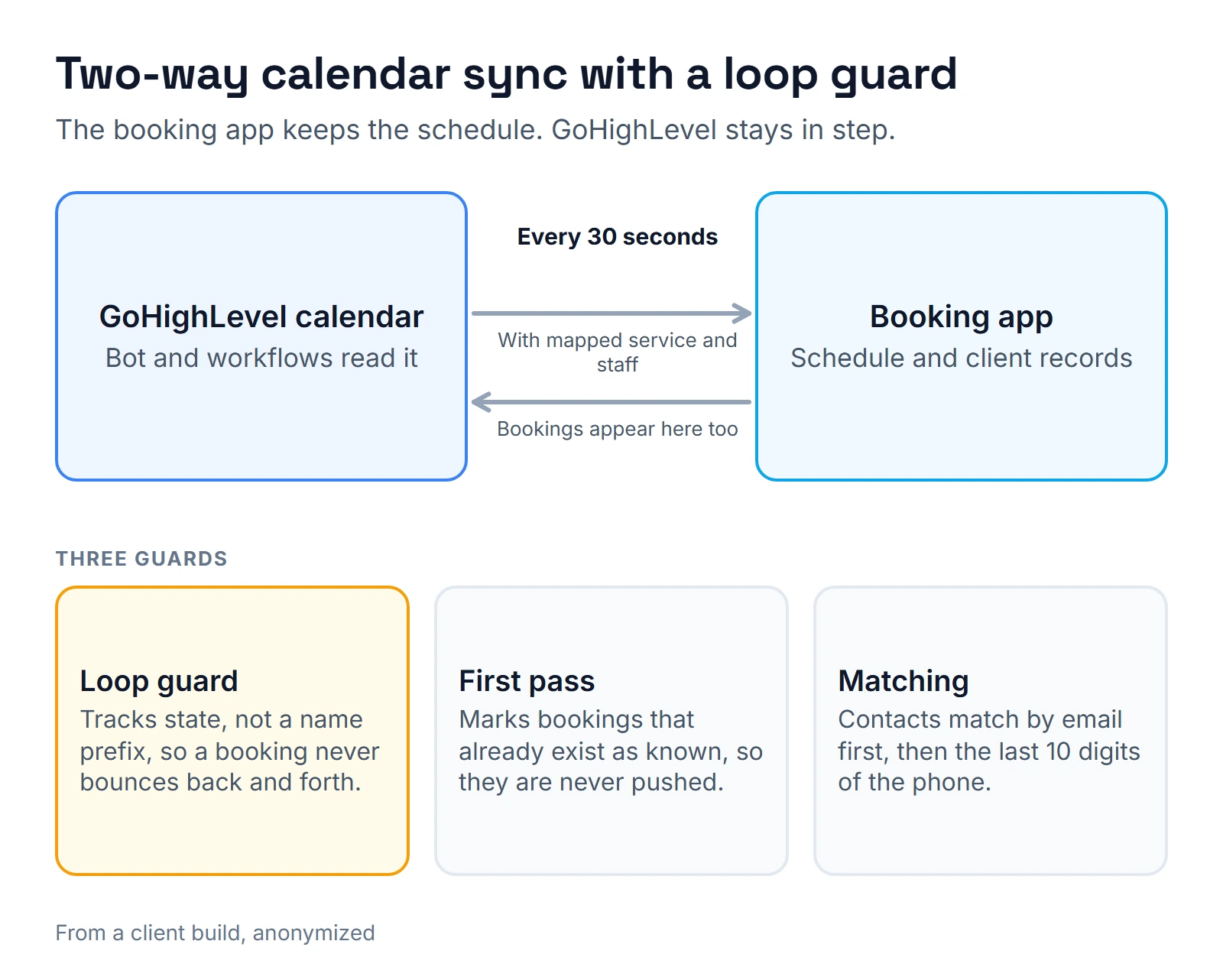
I built a two-way sync that runs every 30 seconds. Appointments made in GoHighLevel appear in Boulevard with the mapped service and staff member, and Boulevard bookings show up in GoHighLevel. A loop guard stops a booking from bouncing back and forth, and a first pass marks existing staff bookings as already known so they are never pushed again. The sync mirrored 42 upcoming appointments, 21 of them newly pushed.
That job taught me the rule behind everything else. A med spa CRM works beside the booking app, not instead of it.
The booking app keeps the schedule and client records. GoHighLevel handles lead response, DMs, reminders, reactivation and reviews, and it is only as good as its link to the booking app. These are the five steps I follow.
Step 1: Which calendar does your bot or workflow read?
Every booking app needs its own answer. This is what I built or found for each.
| Booking app | What I built or found |
|---|---|
| Boulevard | Two-way calendar sync every 30 seconds. For a second spa I added real availability per provider: GoHighLevel to Boulevard in 2 seconds, Boulevard to GoHighLevel in 12 seconds. |
| Square Appointments | A chat bot and a voice agent that book for real from the live catalog and staff list. Square rejects booking-list windows over 31 days. |
| GlossGenius | Two-way sync for hair salons. A booking from GoHighLevel appeared within 30 seconds, but every sync created duplicate clients until I matched on email and phone. |
| Mangomint | I only assessed it. I have not built a sync. |
| Vagaro | In my test, its documented "create customer" call did not create customers, so new clients have to be created in Vagaro itself. |
A sync needs three guards. The loop guard should track state, not a name prefix. A first pass should mark existing bookings as known. And contacts should match by email first, then the last 10 digits of the phone.
The second spa's version also fails closed. If it cannot read availability, it offers nothing instead of guessing.
Ask your booking app's vendor whether API access is available on your plan before you budget for any sync.
Step 2: How fast does a new lead get an answer?
I took a watchdog baseline at a med spa before building its chat bot. The median first response was 36 seconds. The 90th percentile was 73 minutes, and 2 leads in 14 days never got an answer. A 36-second median looks great, but the 90th percentile means roughly one lead in ten waited over an hour.
At a med spa in Pennsylvania the gap was wider. In 14 days it received 58 Facebook form leads that included a phone number, and none of them got a call. I built a chain that dials new form leads about 45 seconds after they arrive. The med spa speed to lead case study has the numbers.
The same pattern works for texts, so read missed call text back too. If your leads come from Facebook, check the GoHighLevel Facebook lead form guide first. Then watch for the merge race. A Facebook lead can arrive as two contacts that GoHighLevel merges 1 to 2 seconds after the webhook, and a fast reply lands on the deleted one. The New Jersey spa's bot now waits, then finds the lead again by phone or email.
Step 3: What should a med spa bot refuse to do?
A booking bot should refuse six things.
- Medical questions. The agency's rules for these bots include a medical-question wall. The bot does not answer them and hands them to staff.
- Weekday math. One bot told a client "moved you to Friday" with zero tool calls, and it got the weekday wrong. The client showed up to no appointment. Now the tools return a weekday table, and a change counts only if the tool succeeded.
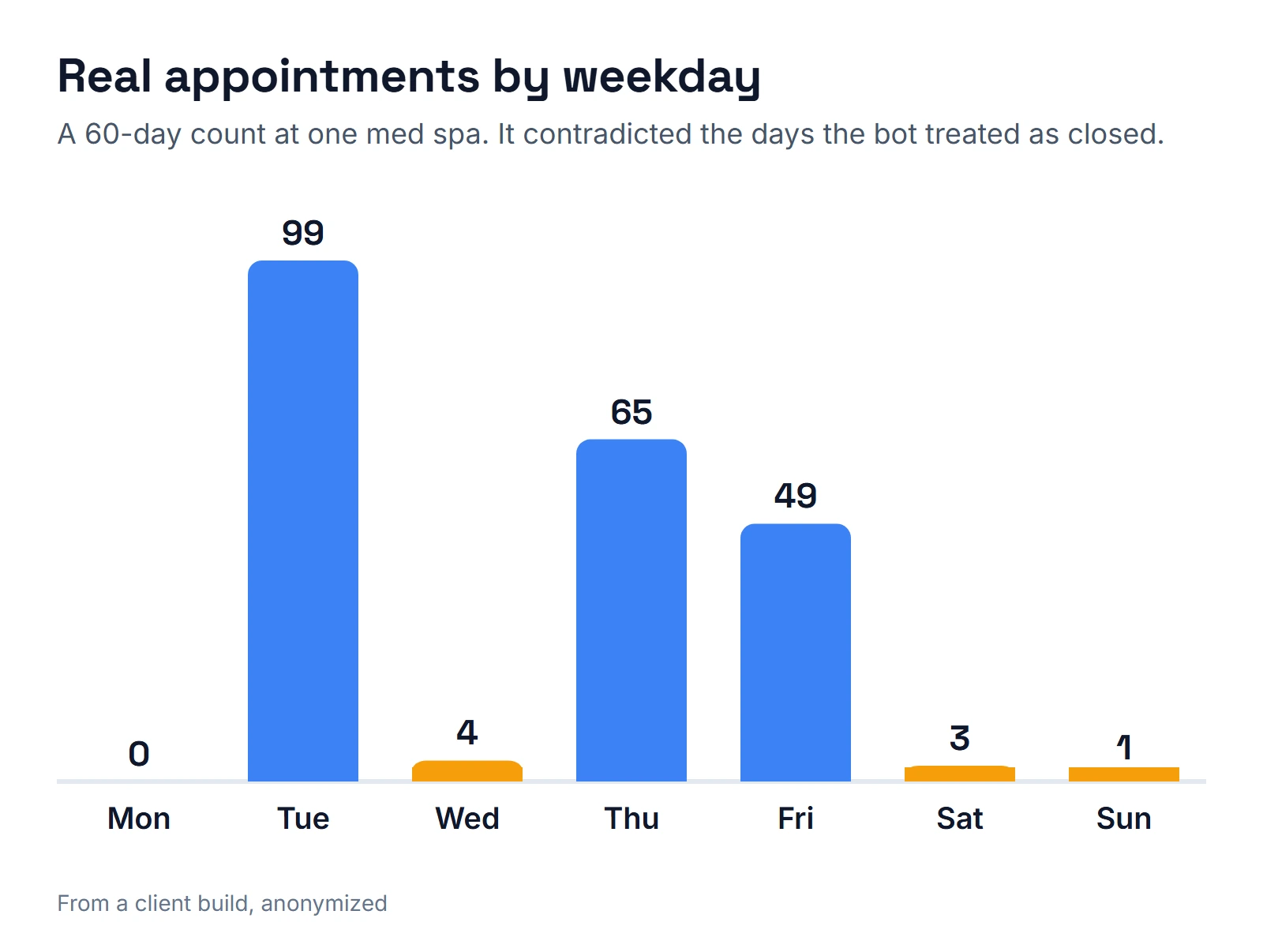
- Guessing open days. One calendar had empty opening hours and offered closed days. A 60-day count of real appointments showed Tuesday 99, Thursday 65, Friday 49, Wednesday 4, Saturday 3, Sunday 1 and Monday 0. It contradicted the days the bot treated as closed.
- Inventing answers. A bot built from raw API calls received every tool result as an empty string, so it invented times, prices and bookings. I rebuilt it by cloning a workflow that already worked.
- Booking closed days. A bot booked a real client on a Sunday because one staff member's Square schedule had Sundays open. Now the tool itself filters out Sundays.
- Replying twice. Overlapping polls made the bot answer the same message twice. Claiming each message in a database before replying fixed it, and a pre-send guard blocks double messages.
Then test. For an agency that runs chat bots for several clients, I built a QA digest that posts three times a day. Panel QA for one spa's bot passed 102 of 105 tests. The AI voice agent in healthcare post covers the same testing for phone agents.
Step 4: Who follows up on quiet leads?
I use a reactivation tagger. It marks leads at 15 minutes, 24 hours, 2 days and 7 days. A refusal guard leaves people who declined alone, and a business-hours gate keeps messages inside business hours.
The first run at one spa tagged 94 contacts, and 8 of them were wrong. I cleaned those up. The second run tagged 1. At a facial spa in New Jersey, the first run tagged 68 backlog contacts, and no lead gets more than 4 touches.
One more trap for any refusal guard: a text that fails with a carrier error can leave SMS do-not-disturb switched on in GoHighLevel. A guard that counts that flag as a refusal silences a lead who never said no.
Step 5: What stays out of the CRM?
Medical details. Whether HIPAA applies to your spa is a question for your compliance advisor, not your CRM builder, and I don't claim any setup of mine is HIPAA compliant.
What I can point to is on an official page. HighLevel's HIPAA help article, last modified June 11, 2026, says HIPAA compliance is not switched on by default. It describes HIPAA as an optional add-on at $297 per month that includes a business associate agreement. It also says the add-on cannot be disabled once purchased, so decide before you buy.
Whatever your advisor decides, keep treatment notes and symptoms out of contact notes and custom fields. Store the service a person wants and the time they prefer. If you want help setting this up, see my med spa page, my guide to hiring a GoHighLevel expert, or the calendar below.
FAQ
Can GoHighLevel sync with Boulevard or Square?
I have built both. Boulevard got a two-way calendar sync, and Square got a chat bot and voice agent that book live. What you can do depends on the access your booking app gives you, so ask the vendor about API access on your plan before you budget.
Does a med spa need a CRM if it already has a booking app?
The booking app keeps the schedule and client records. A CRM answers new leads and DMs, runs reminders and follow-up, and asks for reviews. In the New Jersey case, the missing link between the two caused the double-booking risk.
Is a med spa CRM HIPAA compliant?
Not by default, according to HighLevel's own article. Its HIPAA add-on is a paid package that comes with a signed business associate agreement. Your compliance advisor decides whether that is enough for your spa.
Should a chat bot answer treatment questions?
Only from a list your spa approves, such as services and hours. Medical questions should go to staff. A wall like that is the first rule I would write for these bots.
How do I stop a bot from double-booking?
Make it read the real calendar. Sync the booking app with loop guards, and count real appointments by weekday to check the bot's idea of open days. Then test it with a second AI agent that plays the customer, as I did for a California med spa's phone receptionist. How AI receptionists work covers that method.
About the author

Carlos Familia, CRM & AI automation expert. GoHighLevel, n8n, AI agents, servers. Full-stack developer.
I build CRM systems in GoHighLevel, n8n automations on my own servers and AI voice and chat agents for service businesses. Full-stack developer: I write the workflow, the API integration, the database and the server it runs on, and I test every build with real journeys before handoff.
Book a call with Carlos
In 30 minutes we look at how you get customers today and what to automate first. Pick a time · contact@bluemiraisystems.com