Auto Repair CRM: 12 Questions Shop Owners Ask, Answered
Do auto repair and collision shops need a CRM next to Shopmonkey or Tekmetric? 12 questions answered from a real GoHighLevel build for a Texas body shop.
By Carlos Familia, CRM & AI automation expert. Updated . 7 min.
On a body shop build in Texas, the changelog for the Facebook chat bot said "live". I checked the account instead of the notes. The router was inactive, with 0 executions.
About 181 Facebook conversations had gone unanswered by the bot while it sat switched off. The shop serves a Spanish-speaking market.
That build is where the questions below come from. The short answer to the first one: in my view most shops benefit from a thin CRM layer, but only for leads that arrive outside the shop software, such as Facebook messages, ads, missed calls and WhatsApp. Shopmonkey and Tekmetric already cover estimates, inspections, reminders and customer texting, and both list reputation or review tools, as you'll see below.
Do I need a CRM if I already run shop management software?
Maybe not. Shopmonkey's site lists estimates and invoices by text or email, digital inspections, automatic appointment confirmations and reminders, built-in customer messaging, payments, and CRM Essentials for online reputation and repeat customers (a paid add-on on its pricing page). Tekmetric's site lists estimates with vehicle-specific labor times, digital inspections, two-way texting in a shared inbox, online booking, automated reminders, scheduled campaigns and automatic Google review requests after checkout. Neither homepage shows prices, but both publish them (see the cost question below).
If your shop software already texts, reminds and asks for reviews, a second system adds cost. A CRM earns its place when leads start somewhere else: Facebook DMs, ad forms, phone calls, a website popup.
My rule for splitting the work: if the lead arrives inside the shop software, the shop software owns it. If it arrives outside, the CRM owns the first reply, and the shop software takes over when the car arrives.
How is a collision shop's CRM different, and what pipelines does it need?
Insurance and rentals. In the Texas build, the shop didn't have one "customer" pipeline. It had four:
- Production, 14 stages
- Marketing, 11 stages
- Outstanding payments and insurance recovery, 9 stages
- Rental billing, 6 stages
The last two pipelines track money: payments still outstanding, insurance recovery and rental billing. A repair shop with no insurance work has no use for them. The account ended up with 31 custom fields and 11 workflows.
I'd keep one rule from this build: a pipeline should answer a question the owner asks every week. "Who is waiting on an insurance check?" is a pipeline. "Everyone who ever called" is a list.
Which automations should I build first?
The 11 workflows in the Texas build covered:
- Appointment confirmation with a photo request
- No-show follow-up
- Review request
- Missed call reply
- Free estimate offer
- A website popup that opens a WhatsApp conversation
Start with the missed call reply (the missed call text back guide covers it) and the confirmation. Texting needs an approved registration first (see below), so email and WhatsApp can carry the early load.
Give each workflow an exit. A customer who has booked should leave the estimate and no-show sequences. I learned that on a roofing account in Kentucky, where booked clients were still getting nurture emails until I added the exit.
Can an AI receptionist handle accident calls?
It can, if it doesn't ask every question of every caller. An accident caller needs empathy first and qualification second: insurance or out of pocket, and whether the car needs a tow. For collision shops in California I built an inbound qualifier with conditional branches:
- Empathy is skipped for price shoppers.
- Towing questions appear only if the car isn't drivable.
- Insurance questions appear only when the customer is going through insurance.
- The other driver's insurer is asked only when the caller was not at fault.
The agent scores each caller hot, warm or cold. I don't have call outcome numbers for these builds.
In a different build, fast speech-to-text turned "a tattoo" into "account two". Ask your builder to test car makes and models with real recordings. The AI receptionist guide explains the testing.
How do I stop an AI agent from making things up about my shop?
Give it only facts you have confirmed, and make the limits explicit. For one of the California collision shops, the client's details couldn't be verified, so the agent states no address, no certifications and no warranty terms. It qualifies the job and nothing else.
That sounds strict, and it is the point. In a tattoo studio build, an agent once invented a location in another country. For the Kentucky roofer I gave the bot a knowledge base built from the manufacturer's guide that states what it may and may not claim.
Don't rely on a prompt rule alone. In a med spa build, a prompt rule did not stop a bot from asking for a time in every reply. A limit enforced in code did.
Why can't my voice agent text a tow link?
Because the number it texts from has to be registered. A demo intake agent I built for a collision shop had a tool to text a tow link, and the texts failed: the sending number had no A2P registration. Switching to the provider's pre-approved number pool doesn't help, because that pool only sends fixed templates.
Fix the number first, then build the tool. The GoHighLevel A2P 10DLC guide lists what reviewers check.
How do I know my chat bot is actually on?
Don't trust the changelog. Open the execution list and count. A bot that is "live" has executions. The Texas router had 0.
Then send a message from a test contact and watch the run. Do that after every change, because a bot can stop answering without showing an error.
Does it work for Spanish-speaking customers?
Yes, with care. The Texas shop had a Spanish landing page and a website popup that opens WhatsApp. Two checks matter:
- Dropdown values must match exactly. In a credit repair build, "Si" and "Sí" were different options, and a write that didn't match failed silently.
- Voices must match the language. In another build, a Spanish voice "pronounced everything wrong" because it was an American-accent voice on a fast English model.
Keep one language tag per contact so every workflow knows which branch to use. And if you use WhatsApp templates, know that they are not portable across business accounts. I learned that on a credit repair build.
How should a shop ask for reviews?
Ask everyone. Your shop software may send the request for you: Tekmetric's site, for one, says review requests go out automatically after checkout. Whoever sends it, don't filter the ask by how happy the customer seemed.
Google's review policy says merchants may not "selectively solicit positive reviews". I filter by rating only when thanking a customer, never when asking. In GoHighLevel that means one request to everyone, then a thank-you for high ratings and a service recovery path for low ones.
What else goes wrong on a new shop account?
Three things I found on the Texas account, none visible in the workflow list:
- A calendar with hours set to 0:00 to 0:00. Read the hours yourself. On a different account, a calendar with empty hours returned no error and zero bookable days, so nobody could book.
- No pixel installed. Ask whether the site that receives your ad traffic has one.
- An unsynced OAuth token. The voice app was installed, but its token never synced.
You find these by opening settings, not by reading workflows.
If you inherit a shop account, I'd start with four checks:
- Count the executions of every bot that is supposed to be live.
- Open each calendar and read its hours.
- Check that the pixel exists.
- Send a test message through every connected app.
How much does an auto repair CRM cost?
These are the figures on each vendor's pricing page on October 14, 2026:
| Tool | Entry plan shown | Notes on the page |
|---|---|---|
| Shopmonkey | Basic $239 a month, or $215 a month billed annually | Higher tiers (Clever, Genius), custom Multi-Shop pricing, paid add-ons |
| Tekmetric | Start $199 a month, or $179 billed annually | Unlimited users; two-way texting is listed from the Scale plan |
| HighLevel | Starter $97 a month | Unlimited $297, Agency Pro $497; email, SMS, calls and AI agents billed by usage |
Comparing like with like means adding up three lines: the shop software, the CRM subscription and the usage charges. If the shop software's own messaging already covers your leads, the second and third lines may be zero.
Is there a ready-made collision repair setup?
Yes. The collision repair Automation Pack is my collision demo account's system as a GoHighLevel snapshot, for $22. That demo has 68 workflows, one fewer than my other niche demos.
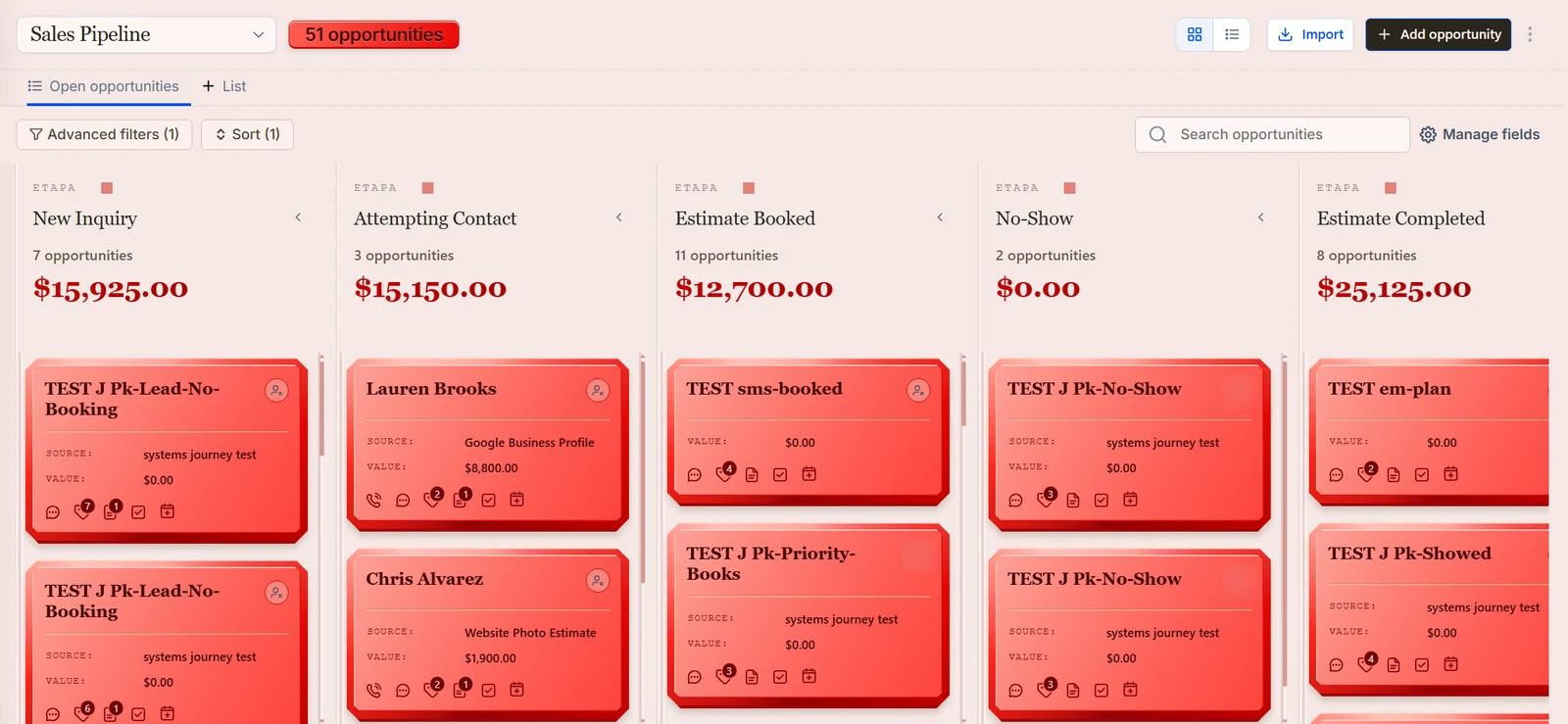
I test it alongside seven other niche demos, and one round of 268 journey tests passed across the eight. For the wider picture, see home service CRM and the local business industry page. You can also book a call if you want me to check your own account.
About the author

Carlos Familia, CRM & AI automation expert. GoHighLevel, n8n, AI agents, servers. Full-stack developer.
I build CRM systems in GoHighLevel, n8n automations on my own servers and AI voice and chat agents for service businesses. Full-stack developer: I write the workflow, the API integration, the database and the server it runs on, and I test every build with real journeys before handoff.
Book a call with Carlos
In 30 minutes we look at how you get customers today and what to automate first. Pick a time · contact@bluemiraisystems.com