Insurance Agent CRM: 12 Questions, Answered From Real Builds
Is there a free CRM for insurance agents? Straight answers on pricing, beneficiaries, bilingual leads, booking bots and compliance, from real agency builds.
By Carlos Familia, CRM & AI automation expert. Updated . 6 min.
The owner of an insurance agency in Puerto Rico told me twice that the WhatsApp bot was telling leads "you're booked" and nothing showed up on the calendar. At the same time, leads from a cancer-policy Facebook ad weren't reaching the CRM at all. Both turned out to need small fixes: the bot got a booking action on the right calendar, and the Facebook lead forms got mapped to fields. Once the forms were mapped, 39 stuck leads landed in the account within about 3 minutes. That pattern, a small fix behind a big cost, runs through most of the questions below.
Is there a free CRM for insurance agents?
Not with GoHighLevel, which is the platform I build on. There's no free plan: the pricing page offers a 14-day trial, then $97 a month for Starter, $297 for Unlimited and $497 for Agency Pro. I can't speak for other tools, because I haven't built insurance systems on them.
The bigger cost is build time. If you'd rather install than build, the insurance Automation Pack costs $22: a GoHighLevel snapshot with the workflows ready, installed into your own account. The insurance industry page shows how I approach the rest.
What should an insurance agent CRM track?
More than a name and a phone number. For a brand-new life insurance agency in California, I started from an empty account and built 31 custom fields, 3 pipelines (with 11, 4 and 5 stages), 20 custom values, 47 tags and 3 calendars. Custom values are the shared pieces, like the agency name, sender and booking link, so you edit them once and every message updates.
The point of the fields is dates. In a Utah agent's book of 527 contacts, 126 were tagged "client" but only 10 had a policy start date. Renewal reminders and birthday outreach can't run on dates that don't exist, so the first job of a CRM is to show you that gap.
How do you track beneficiaries?
As their own contacts, linked to the policyholder. For the Utah life insurance agent, the intake form creates the insured as the principal contact, each beneficiary as a linked contact, two opportunities and a consent note. When a policy issues, every beneficiary gets tagged, which replaced an earlier n8n flow.
The agent also wanted one screen for birthdays, follow-ups and the pipeline. I built it as a console embedded in GoHighLevel with KPIs, a birthday list, holiday reminders, a kanban board and a beneficiary tree. Automatic texts from it have a double kill switch.
How should leads move through the pipeline?
By stage, with one folder of workflows per stage. The California agency ended with 46 workflows live in 23 stage folders. Thirty-one came from shapes I'd already proven in production, 14 were built with my workflow compiler and 1 already existed. There's also one workflow per objection reason and one per call outcome, so each reason and each outcome gets its own sequence.
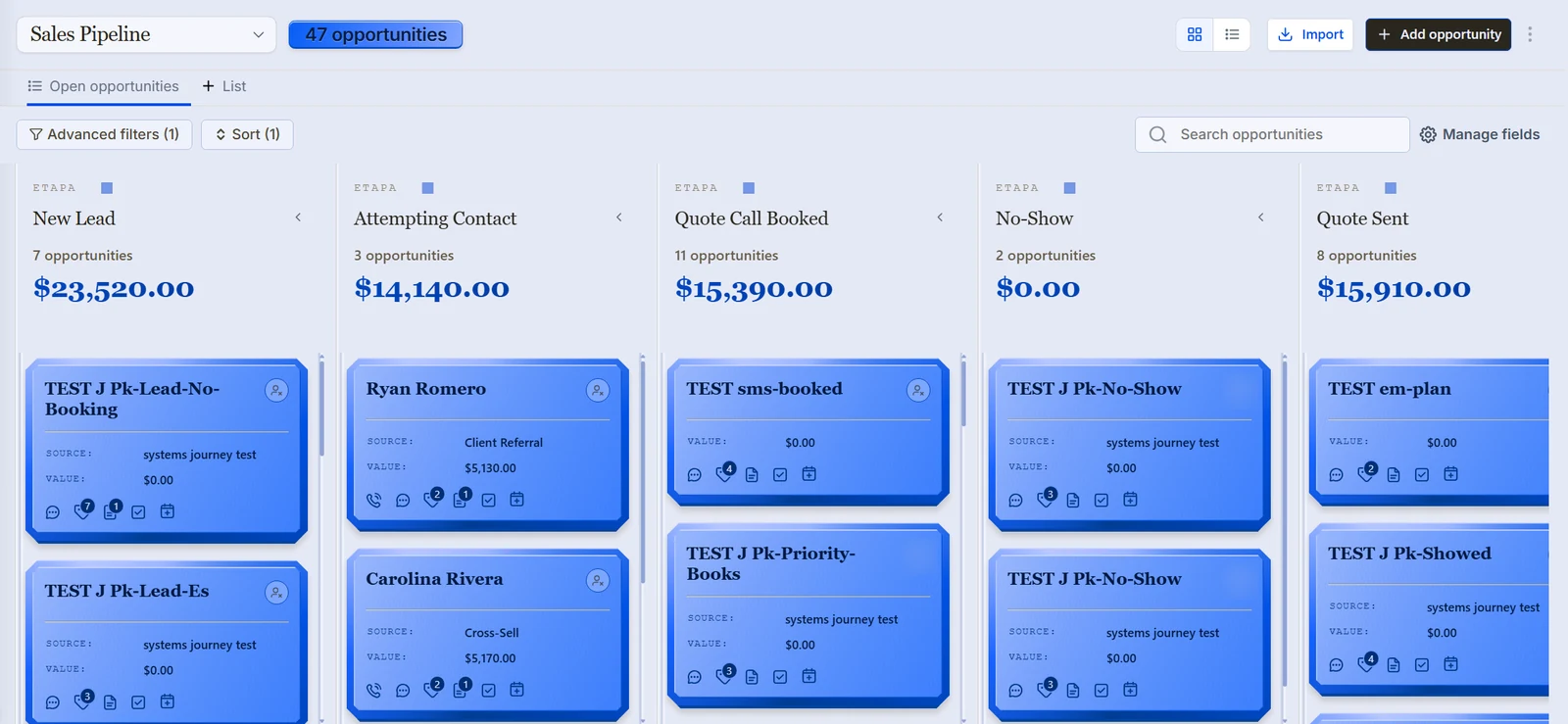
After the build, the integrity scan found 0 problems and the execution tests passed 10 of 10. I also gave the agency a roadmap with one card per workflow. Checking the card text against the live definitions turned up 47 fixes, which is why I do it.
One rule to know: GoHighLevel allows only one opportunity per contact in each pipeline, and an abandoned one still counts. In the Puerto Rico build, the workflow that moves the auto-insurance opportunity when an appointment is confirmed only moves it forward, never backward.
Why aren't my Facebook leads showing up?
In the cases I've handled, the form wasn't mapped. GoHighLevel drops the leads from a Facebook form that has no field mapping. The 39 leads in the story above arrived only after I mapped two forms to new fields.
The catch: those backfilled leads did not fire any workflow. They sat in the account without a text or an alert. After you map a form, plan a one-time follow-up for the backlog. There's more in GoHighLevel Facebook lead form not working.
Why did my bot say "you're booked" when nothing was on the calendar?
My read is that nothing forced the bot to book before it confirmed. The fix in Puerto Rico had two parts: a booking action on the correct calendar, and a prompt rule to confirm only after the reservation exists.
Testing has traps of its own. GoHighLevel's trial chat can book real appointments if the scripted lead accepts a slot, and during my QA on that build one landed on the owner's calendar. Point tests at a calendar no real person uses. On the California build, a calendar created by API without a slug made its share link open another company's calendar. Open every link you share in a private window.
What is the quiet way a chat agent fails?
It stays silent. In the California build, the website chat agent was on auto-pilot but answered nobody for a day, because no channel had been assigned in its routing. The trial chat passes anyway, so the test looks fine.
Other quiet failures from that build: a user's own work-hours schedule overrode the calendar's hours, the meeting type said the client would call instead of the agent, and a second website used a different widget that wasn't in the routing. For how these agents work, see how AI receptionists work.
Can the CRM handle English and Spanish leads?
Yes, if you decide the rules up front. The California agency has a bilingual voice intake agent; its Spanish phone test passed in full on a 143-second call. The Puerto Rico agency works in both languages.
Three details matter. Use one language tag per contact, because on a mortgage account, mixed tags had English speakers getting Spanish reminders. Match dropdown values exactly: in a Spanish-language build, "Si" and "Sí" were different values and the write failed silently. And do not assume templates move between WhatsApp business accounts, because they don't.
What rules apply to calling and texting leads?
This isn't legal advice, but three rules come up in every build. The FCC's telemarketing rule, 47 CFR 64.1200, allows no telephone solicitation to a home phone before 8 a.m. or after 9 p.m., local time where the person is. It also requires prior express written consent before a telemarketing call that uses an artificial or prerecorded voice on a residential line. And texts won't deliver until A2P registration is approved; see GoHighLevel A2P 10DLC.
For the California agency, a compliance review added an AI disclosure and a recording notice to the voice agent, and flagged California's two-party consent rule. Ask your builder who does that review for you.
Is it safe to put a dashboard inside my CRM?
Only if someone proves who can see the data. An embedded dashboard is still a web page, and it can hold far more than it shows. The Utah console keeps a cached copy of all 527 contacts. That copy is the part to protect.
Ask any builder who embeds a dashboard: what stops a stranger from loading the page, how do you know, and can I see the test?
Can the same CRM recruit new agents?
Yes. For a financial services agency I built a 12-workflow recruiting pipeline: candidate outreach that stops on reply, career-overview booking and reminders, an application form, interview booking, an ownership transfer for the final interview, offer follow-ups and an opt-out handler. A test with 3 contacts produced 47 outbound events with 0 errors.
Two older workflows that conflicted with the new ones were disabled. If you add a recruiting pipeline to a sales account, look for overlaps before you switch anything on. For messaging that books and follows up on its own, missed call text back is a good first workflow to test.
Should I build this myself or hire someone?
Build it yourself if you have one pipeline, one calendar and time to test every path. Hire help when you have beneficiaries, two languages or an embedded dashboard. A GoHighLevel expert should be able to show you a test run on a dummy contact. If you want to talk it over, use the calendar below.
About the author

Carlos Familia, CRM & AI automation expert. GoHighLevel, n8n, AI agents, servers. Full-stack developer.
I build CRM systems in GoHighLevel, n8n automations on my own servers and AI voice and chat agents for service businesses. Full-stack developer: I write the workflow, the API integration, the database and the server it runs on, and I test every build with real journeys before handoff.
Book a call with Carlos
In 30 minutes we look at how you get customers today and what to automate first. Pick a time · contact@bluemiraisystems.com