Personal Injury CRM: The First 14 Days of a New Inquiry
A personal injury CRM should answer an inquiry in minutes, keep one owner on it and stop itself when it should. Here is the 14-day timeline I would set up.
By Carlos Familia, CRM & AI automation expert. Updated . 7 min.
A legal intake firm is one of the users of a voice AI app I made for agencies that run GoHighLevel. Each sub-account on it gets its own call queue, its own skip rules and a health page that shows whether the system is running. The rule the whole app is built around is that a firm sees its own calls and nobody else's. I check it the blunt way: a request from outside the account has to come back with nothing.
That is why, when a law firm asks me about a CRM, my first question is who can see the file. Speed comes second.
A personal injury CRM has three jobs: answer each new inquiry within minutes, keep one named person responsible until the person signs or is declined, and keep every record private to your firm. Case files, deadlines, billing and medical records stay in your case management software. The rest of this post is the timeline I would set up for one inquiry, with what breaks at each step.
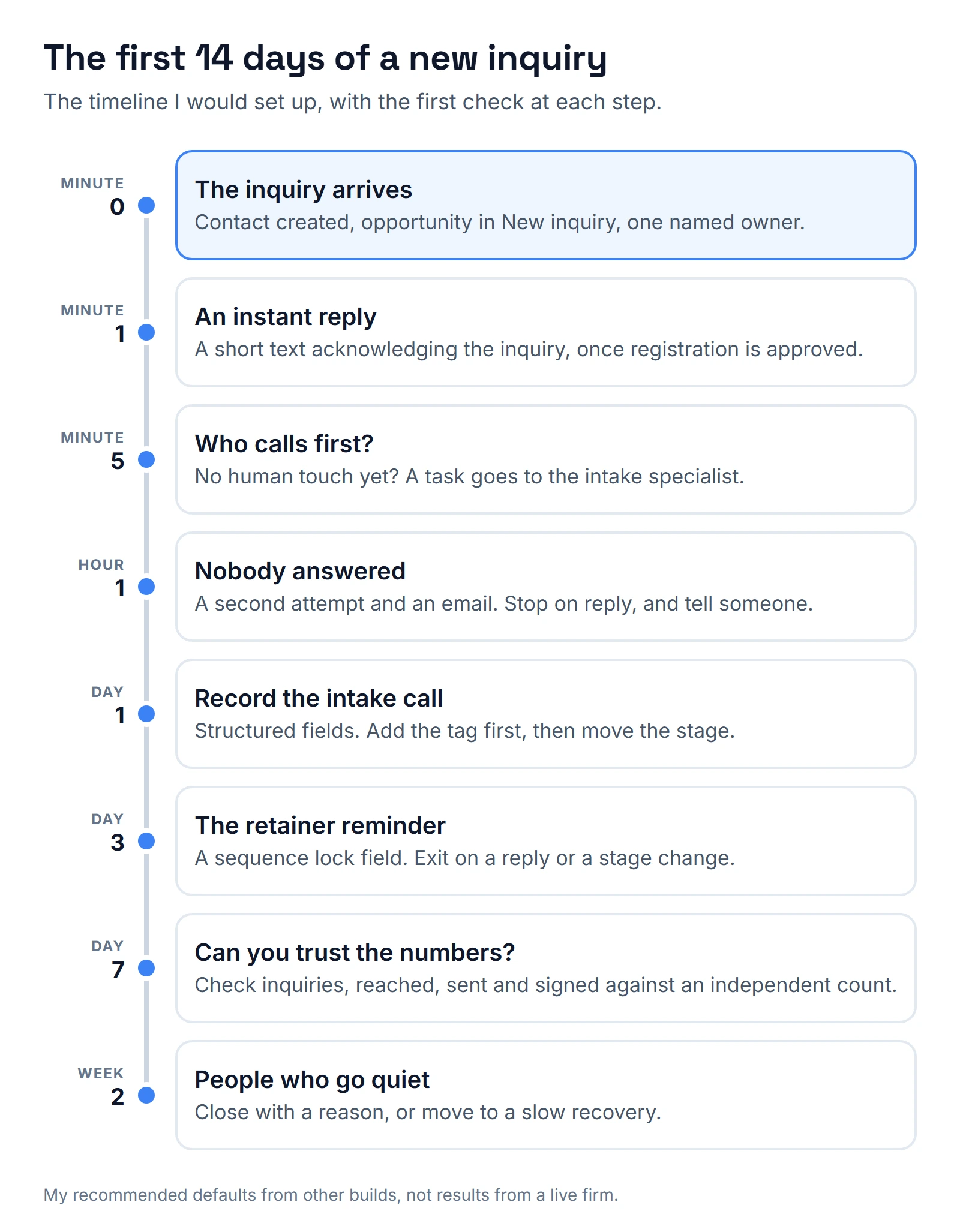
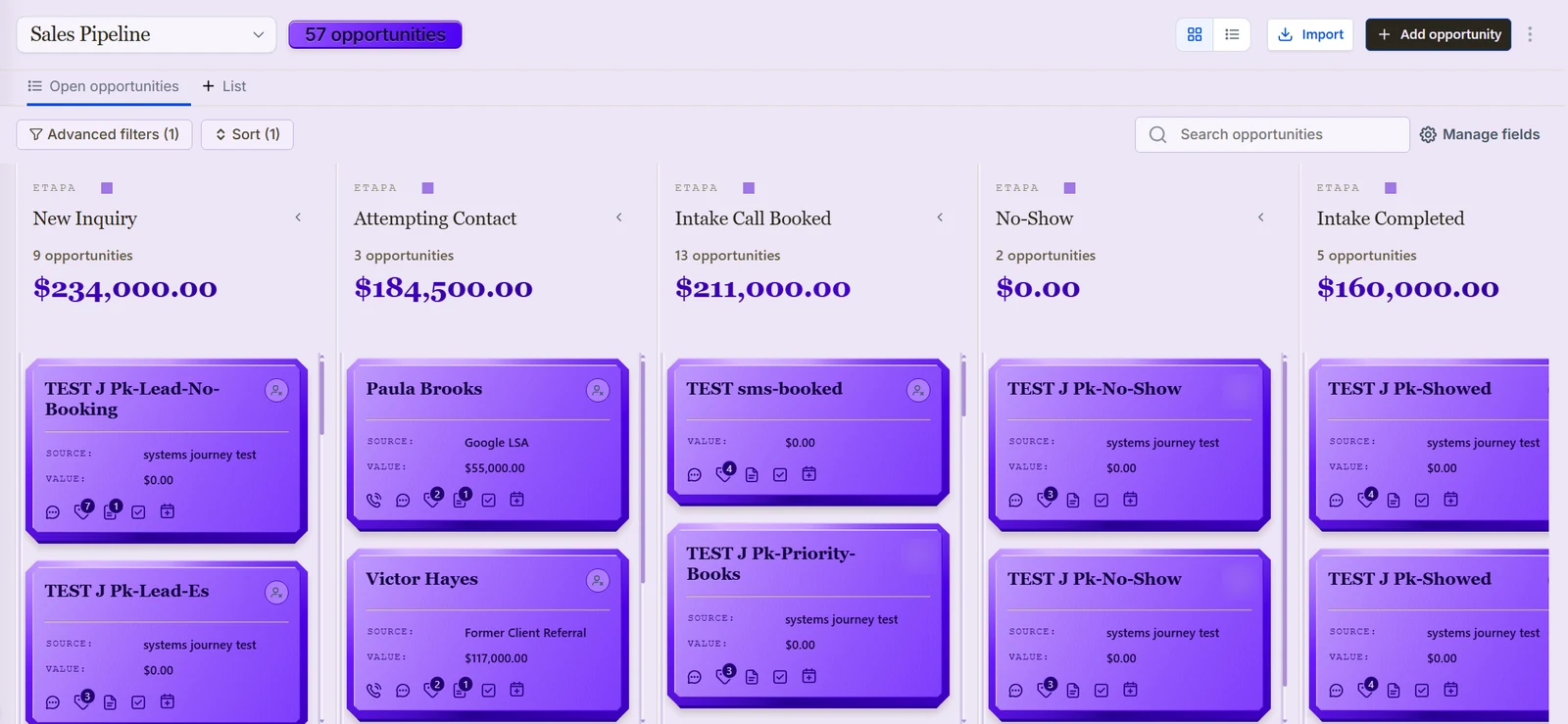
One caveat. I have not run intake for a live personal injury firm, so the times below are my recommended defaults, not results from a firm. What I can show is a tested demo build, the personal injury pack, a GoHighLevel snapshot for $22.
Its demo account has a niche pipeline, custom fields, 30 fake do-not-disturb contacts and 69 workflows, with English and Spanish branches. I can also show failures I have hit in other industries that would hit a firm the same way.
Minute 0: What happens when an inquiry arrives?
Three things should happen at once. A contact is created, an opportunity lands in a "New inquiry" stage, and one named person becomes the owner. Inquiries arrive from your website form, ad forms and phone calls, and each source has a known way to fail.
- The website form says thanks and throws the lead away. At a real estate lending marketplace, the form's route only logged the submission and returned success. Every enquiry since launch was discarded. Submit your own form and find the contact.
- An unmapped Facebook form drops its leads. At an insurance agency in Puerto Rico, 39 leads sat stuck until I mapped two forms. The GoHighLevel Facebook lead form guide shows the steps.
- A lead with no owner skips the task. An "Add Task" step assigned to the contact owner is skipped when nobody owns the contact. New inquiries have no owner yet, so assign one first.
Minute 1: Does the person get an instant reply?
They should get a short text acknowledging the inquiry, and anyone whose call you missed should get one too. The wording for that second text is in missed call text back.
Don't depend on any of it until your A2P registration is approved. An HVAC company in California had its A2P rejected, so SMS waited and email went out first. My GoHighLevel A2P guide covers what got brands approved.
Use one language tag per person. In a mortgage brokerage, mixed language tags sent Spanish reminders to English speakers, and I moved 33 contacts to a single tag. If you serve Spanish-speaking clients, the first text should match their language.
Have your ethics counsel read every automated message before launch. Rules on lawyer advertising and solicitation vary by state, and I do not give legal advice.
Minute 5: Who calls first?
My default is simple. If no human has touched the inquiry in five minutes, the workflow creates a task for your intake specialist. I use tasks instead of notifications because a task stays open until someone closes it. In the mortgage account I audited, task steps outnumbered direct user assignments 71 to 2.
Calls need a window too. The FCC's telephone solicitation rule bars solicitation calls to residential subscribers before 8 a.m. or after 9 p.m. in the called party's local time. Whether your callbacks count as solicitations is a question for your counsel.
When I built a dialer for a med spa, it read the time zone from the area code and skipped numbers it could not place. I would copy that rule for a firm.
For a speed reference, I configured that med spa's first AI call to go out about 45 seconds after a form arrived. The med spa speed to lead case study has the details. I would not put an AI voice agent on a legal intake line without counsel's approval. The basics are in how AI receptionists work.
Hour 1: What if nobody answers?
Send a second attempt and an email. The sequence should stop when the person replies, but every stop must tell someone. In a roofing build in Kentucky, stop-on-reply ended sequences and nobody was told.
Treat a failed text as a failed delivery, not a request to stop. A carrier error can make GoHighLevel set SMS do-not-disturb on the contact, and a bot that reads that flag as STOP will never text that person again.
Day 1: How do you record the intake call?
Move the card with structured fields, not free text. Add the tag first, then move the stage. At a wellness clinic, every workflow moved the stage first and added its guard tag after. The next workflow started before the tag existed, and people got each follow-up two or three times.
Decide with your ethics counsel which details live in the CRM and which stay in the case management software. A CRM field is easy to read and easy to export, so store less there.
Day 3: What if the retainer goes out and nothing comes back?
Run a reminder sequence with a "sequence lock" field, so two sequences never message the same person at once. I built that lock into an estimate follow-up for an HVAC company in California. For a firm, have the retainer sequence exit on a reply or a stage change.
Record why a person declines in one dropdown field. For that HVAC company I built one workflow per reason. A dropdown write must match the option text exactly, or it fails without an error. In a credit repair build, "Si" and "Sí" counted as different options.
Day 7: Can you trust the numbers?
By the end of the first week you want a count: inquiries, contacts reached, retainers sent, retainers signed. Do not trust a dashboard until you have checked it against an independent count. In a mortgage brokerage I verified a metrics engine three times against a separate script. The same work exposed a data gap: 111 open opportunities stuck in the Funded stage.
For a firm, the same check catches inquiries that never left "New inquiry". Run it every week for the first month.
Week 2: What happens to people who go quiet?
Close them with a reason, or move them to a slow recovery. For the HVAC company, the recovery runs weekly for 12 weeks and exits on a rebook, a reply or a stage change.
Law firms face a problem I first met in mortgage: the second matter. GoHighLevel refuses a second opportunity per contact per pipeline, even when the first is won or abandoned. In a mortgage brokerage in Florida, the setting that allows it switched itself off within about two hours, and a real repeat client broke the flow.
A returning client with a new matter, or a relative on the same phone, needs a plan. Also check that your workflows allow re-entry. Two of my builds started with re-entry off, and in the roofing one, returning leads never got their sequences until I changed it.
What would I change?
If I set this up for a firm tomorrow, three lessons from my other builds would come first. None of them is about features.
- Write the isolation test first. Before any workflow, prove that nobody outside your firm can read your records. It is the first test I run on my own call app.
- Make "owner assigned" the first check. An inquiry with no owner skips tasks and goes quiet.
- Get counsel's sign-off on scripts before publishing. That means texts, call scripts and what the CRM stores.
Then test with fake contacts. My demo accounts use 30 do-not-disturb contacts each, and 268 journeys passed across my eight demos. I explain the method in how I test GoHighLevel workflows. If you want help building yours, see my checklist for hiring a GoHighLevel expert or use the calendar below.
About the author

Carlos Familia, CRM & AI automation expert. GoHighLevel, n8n, AI agents, servers. Full-stack developer.
I build CRM systems in GoHighLevel, n8n automations on my own servers and AI voice and chat agents for service businesses. Full-stack developer: I write the workflow, the API integration, the database and the server it runs on, and I test every build with real journeys before handoff.
Book a call with Carlos
In 30 minutes we look at how you get customers today and what to automate first. Pick a time · contact@bluemiraisystems.com